Friday, August 10, 2012

New version of Fluxx available at Target

Looney Labs recently announced that a new version of Fluxx would be available for the mass market at Target stores.  Recently I was at Target and was excited to see some of our favorite games available there for purchase, such as Lord of the Rings and Munchkin.  I was hoping they would continue to branch out and add more games.

However, this Target version of Fluxx is going to be different from the original.  The press release describes it as having "simpler rules," and contains only the 4 major types of cards (action, keeper, goal, new rule).  They state that 73% of cards are the same.

What do you think about the fact that this version of the game is essentially a more dumbed-down version of the one we're used to?  Is it a good idea to draw in as many potential game players as possible, or do you think this is a bad idea and disappointing for the hardcore game players?

Thursday, August 9, 2012

Poison


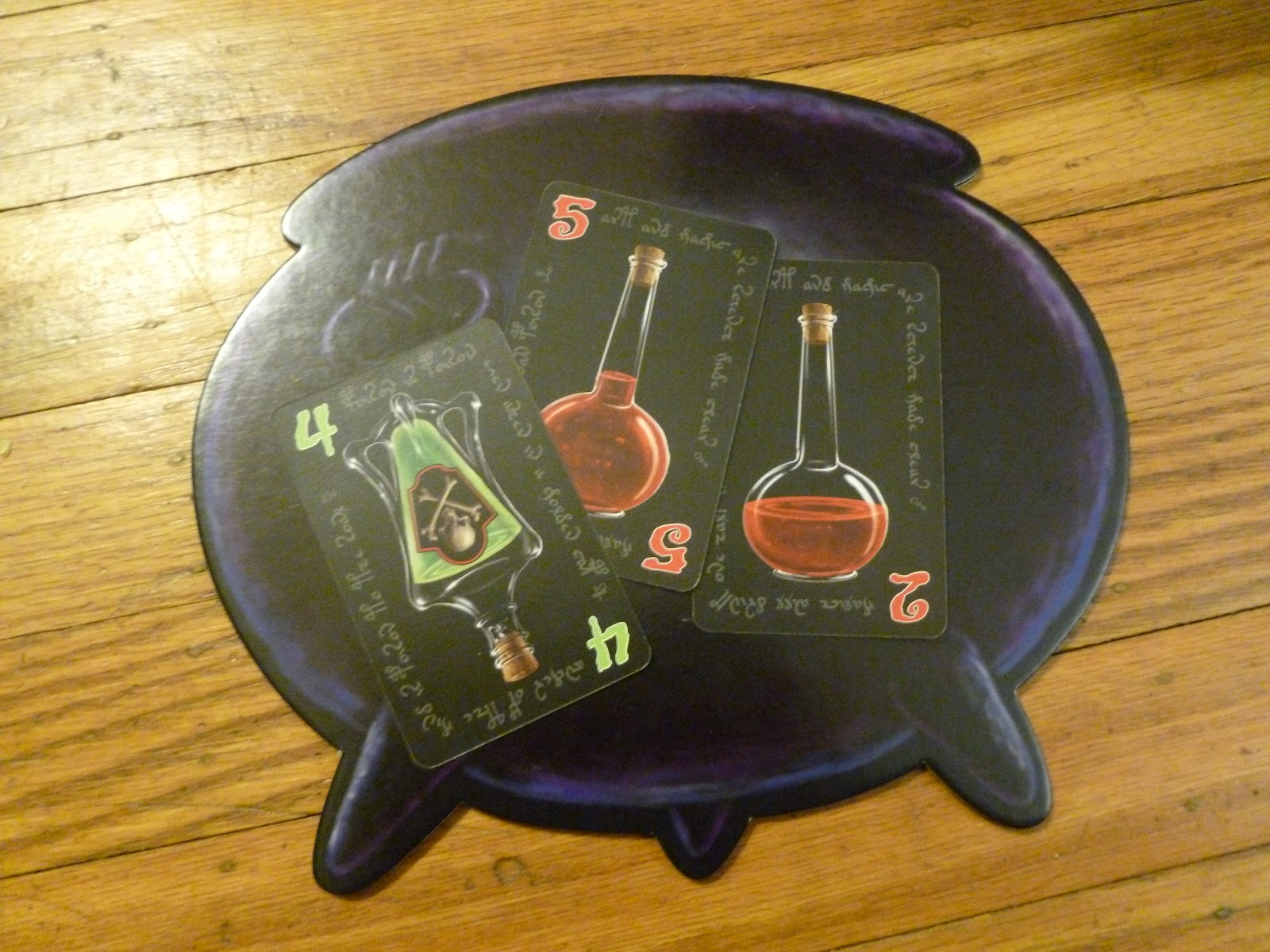
This is a rather short card game coming to us from one of our favorite game designers, Reiner Knizia.  There are three cauldrons in which to brew potions, and set of cards with potions of four different colors - red, blue, purple, and then the green "poison" cards.  Each cauldron can only hold one color (not counting the poison cards), and can only hold up to 13 points total.  The cards have values on them that range from 1 to 7.  Players go around playing potions into cauldrons, and if you force a cauldron to go over 13 points you must take all of the cards in that cauldron.  At the end of the round you tally up the potions.  If you got the most of one color (not counting the poisons) then those cards don't count for you.  Whoever has the least amount of points wins.

Interestingly, there is also a different, slightly simpler version of this game known as Baker's Dozen.

3-6 players.  15-25 minutes.  No expansions available.  Easy learning curve.

Becky says:

I like having some good, quick games that still involve strategy and fun.  This game does that.  At first the strategy seems clear cut - avoid taking any cards.  This is usually done by placing your largest numbered cards, like the 7's, first, so that later on you have some 1's and 2's to help you out in avoiding taking the cauldron.  However, sometimes the strategy of trying to get all the cards of one color will work really well.  You have to make that judgment based on what hand you are dealt.

It's easy to learn and easy to explain, which I appreciate.  It's a good filler game but it also isn't too predictable.  I also appreciate games of numbers, which this essentially is.  Other than that, however, I  don't really have a ton to say about Poison.  It doesn't wow me like some other games do, probably due to the simplicity, but I really appreciate it for what it is.  8 out of 10.

Jason says:
When I host a board gaming night, there are two classes of board games that get played: the big games that can take a lot of focus and energy, and the little, intermittent games that are played to cool down between big games.

Granted, it’s not just black and white, and a little game doesn’t have to be played as a little game, and maybe some people don’t even agree on which little games are little.  All I know is that I don’t think of playing Pandemic as a relaxing “warm-up,” and conversely I won’t call Incan Gold the pinnacle of hard-core gaming.  I would play Incan Gold to get things moving, and when everyone’s gotten comfortable, I will bring out Pandemic.

Poison falls into the “little” category, where it’s a simple game with simple rules and a simple objective.  Sure, it’s not going to floor many people with its amazingly intricate gameplay, but it does very well for the category it’s in.  It is fun, and it is definitely worth having in your collection of games.

The game plays very much like Hearts or Pinochle, yet it has a more contemporary flavor to it.  There is definitely strategy to it, and I think if I played it enough, I could get very, very good at this game.  Despite that, just like Hearts and Pinochle, it’s random enough that periodically you can get a stinky hand that just isn’t meant to win.  That’s not a bad thing either, because it keeps even the skillful potions experts feeling mortal.

Also, the artwork is fascinating, the cards look really cool.  It’s a pretty game, what little there is to be pretty.

Now, let’s bring this back around and think: what did I rate Pandemic and what did I rate Incan Gold?  I bring this up because I want to emphasize a very important point: “little” games are not inferior to “big” games.  In my opinion, Incan Gold beats Pandemic by a whole 2.6 points out of 10, and it is a well-earned extra 2.6 points.

I am really fond of Poison.  I think I will rate it an 8.1/10 and because it’s a little game and because it can be a good gateway game, I give my personal recommendation that every gamer have this game.

Wednesday, July 25, 2012

Playing for fun vs. Playing to win

While we usually have a little bit of each in us, I've noticed that there are really two types of gamers: those that play primarily just to have fun, and those who play more competitively to win.

This was really brought to the forefront when we started attending a board game event with many people we had not played with before.  While we appreciate trying to win, we are mostly in it for fun.  However, we played with some people that cared so much about winning games that they made game playing negative for us.  It was the little things, like not willing to count an extra point because someone felt that rule hadn't been adequately explained to them (mind you, this was at the end of the game and the person was already up about 40 points - counting that one point would not have made any difference).  It's people who use psychological mind tricks to try and get inside your head to affect your strategy - not so cool when I'm playing a game for the first time and still learning.  And it's people that go so far as to almost cheat, like when at the end of the game they find an extra card in the box that wasn't used and decide to add it back in, even though knowing how many cards are left affects the entire gameplay.

And to be completely honest, it's been these experiences that have made me less excited about writing this blog.  If the majority of game players are so crazy competitive, I know they'll scrutinize our reviews and probably won't agree with a lot of what we say because our focuses are different.

I still absolutely love playing board games.  I've just learned that it's better with certain types of people.  Please assure me that those of you who love to play for the fun of it are still out there!  And if you are, let's try to play together sometime :)

Monday, July 9, 2012

If you like Pandemic, then try...

This is a new column we hope to run fairly often, which compares similar games to each other.  If you like one of the games, hopefully you'll like others on the list!  Ideally we hope to add these similar games to the reviews as well, but for now I thought it would be fun to start a separate column.

To kick things off we'll start with Pandemic, a fun cooperative game.  If you're a fan of Pandemic, here are five other games we think you might like:

1.  Flash Point: very similar to Pandemic, but with a bit more added.  The theme of this game is trying to put out fires in a house and save everyone within it.  It's completely cooperative, and in my opinion a bit better than Pandemic because there is more involved.  I only played once, but it seemed pretty challenging as well.

2.  Forbidden Island: The same makers of Pandemic, the game play here feels very similar.  One nice thing is that it plays well with 2 players, making it a fun game if you're a couple or just have one close friend or sibling to play with.  Like Pandemic, there are different difficulty levels, the hardest of which can be quite intense.

3.  Lord of the Rings:  A bit more complex than Pandemic, Lord of the Rings is probably one of the most challenging purely cooperative games we've tried.  It's a ton of fun though.  Like Pandemic, everyone takes a turn but they are all working toward the same goal.  This game also has the rule that you can't share what cards are in your hand, fixing a problem we had with Pandemic.

4.  Red November: Though it's not Jason's favorite, Red November is also a decent cooperative game you might enjoy if you like Pandemic.  Everyone is working together to save a sinking submarine.  It has a similar feel to Pandemic in that it will never feel like you're very close to winning until you actually do - every game seems to come down to the wire.  Plus, Red November can hold up to 8 players - though keep in mind that if you use that many, the game can last for quite a long time (over 2 hours sometimes).

5.  Shadows over Camelot:  It's not completely 100% cooperative, but it's a fantastic game so I have to mention Shadows over Camelot.  For the most part you are working together against the forces of evil, though there is a possibility of a traitor.  You can choose not to play with the traitor to make it purely cooperative, though it tends to be a lot less challenging that way for advanced players.

Tuesday, July 3, 2012

Citadels

Citadels is a card game in which you collect gold in order to build "districts."  Each district costs a certain amount of gold.  The game ends when one person has built 8 districts, and whoever's districts are worth the most (including some end of game bonuses) wins the game.  Every turn you have the option of either taking two gold pieces or drawing two cards and keeping one.  You then have the chance the build a district.  Then your turn is over and it's on to the next person.

It sounds pretty simple, right?  Well, the twist comes in with the roles/characters.  There are 8 characters, each with its own special ability.  The thief can steal gold, the merchant gets a gold bonus, the architect gets extra cards, etc.  The cards are passed secretly around so that you can select your role - and try to guess what the person before you took, and what the person after them took.  It's not as easy as it sounds to pick a role.  If you want more gold, you'll be tempted by the merchant - by the assassin might want to prevent you from getting that gold and will kill the merchant.  It's all about strategy, and who you pick can make or break the game.

2-7 players.  45-60 minutes.  Dark City expansion available.  Medium learning curve.


Becky says:
For some reason, Citadels tends to fly under my radar.  I'm never dying to play it, and I don't think I'd ever suggest it, but if someone else suggests it I'll definitely play.  I just tend to forget about it, mostly.  It is a fun game, it just isn't a stand out for me like some of the others that we've played.

Our group tends to have a rather large problem that others might not experience, and that's how much downtime there seems to be.  We play with many people that really take a lot of time to strategize and plan out exactly what move they're going to make.  The process of choosing what role you want and then pass the cards around can take over 5 minutes for us.  I've heard from other people that their games don't take nearly this long, so this might only be a concern if you know you play with a group of people that like to take their times with stuff like this.  Also, once the round begins, you take your turn one player at a time, and the majority of other players turns don't affect you, so there's some down time there as well.

But on to the good things: it does take some interesting strategy to try and win the game.  If you want to do well you'll be tempted to take the more powerful characters, like the merchant, who gets plenty of extra gold.  But the powerful characters also have a big target on their backs, so you can be sure the assassin and the thief are after them.  You not only have to make good decisions for yourself, you have to predict what you think your opponents will do and how it will affect you.  And they're doing the same thing, so they might do something different than they normally would if they're thinking about what you're doing.  It's definitely a game where it helps to know your opponents and their style of game play.

One other comment - the two player version of this game is a big flop, in my opinion.  Even though they try to change the rules up to make it less predictable, it doesn't really work.  You can still tell pretty easily what your opponent has chosen.  Plus, the person that goes first seemed to have a gigantic advantage and pretty much controlled the game.  I wouldn't bother with it if you've only got 2 players.

Overall, we play Citadels infrequently enough these days that I enjoy it when it does come out, but I'm never dying to play it.  It's good when we need a change from the regular games we've been playing.  I'm also surprised to find out that Jason enjoys it much more than I realized, as you'll see below.  As for me, I give it a 6 out of 10.

Jason says:
Citadels.  It's a game.
Yep.
It's one of my favorite games, actually.

What stands out about this game is the characters and how much sway their powers hold.  Picking the wrong character can cost you a turn, or all of your gold, or a large portion of your points, maybe a combination of the three.  So basically, the stakes are really high every turn.

Also interesting is that it isn't a matter of numbers or excellent strategy, it's actually a matter of understanding your opponents' motivations.  When you lose your gold, it's because someone else decided to steal from your character; tough luck, you might've avoided it had you considered that that person would steal from the character you picked.  Lots of people suggest that they just have rotten luck playing this game.  However, I say that luck really isn't much of a factor in this one.  Instead, it's about figuring out what everyone will do and how you can maximize your profits from the way things will go.  The strategy eludes lots of people, and lots of other people just don't want to put forth the effort to think things through.  Of course, flying by the seat of your pants is a legitimate strategy, but if you're playing with someone who is really attentive, it is also a losing strategy.

So my short description of the game's great qualities is this: the strategy is person-centric and relies only a little on luck; any single turn in this game is high-stakes, giving the game an extra sense of intensity; the game is simple to learn, but monolithic to master.

Citadels has drawbacks too, and one of them is that some people will be intimidated or discomforted from the intensity of the game.  Some people show this through nervousness, while others simply fail to see why it is so intense.  The game is not for everyone.

So, when playing with those kinds of people (the people that this game isn't for) you get several phenomena; they get distracted during character picking, or they stop caring because they don't "get it."  Unfortunately, this brings the game down for everyone, because it's such a person-centric game.  I'll admit, it feels like a slow game, but it will only feel slow if you fail to see the value of paying attention to the important decisions.

This was a tough review, because no words can truly describe what it feels like to play a good game of Citadels.  I will give Citadels a 8.8, and that is out of a possible 9.999995, but since 99.99995% (also known as 5σ) is good enough to declare a discovery in high-energy physics, it's as good as a 10 for me.  So, 8.8/10.

Thursday, June 7, 2012

Survive Escape from Atlantis: first thoughts

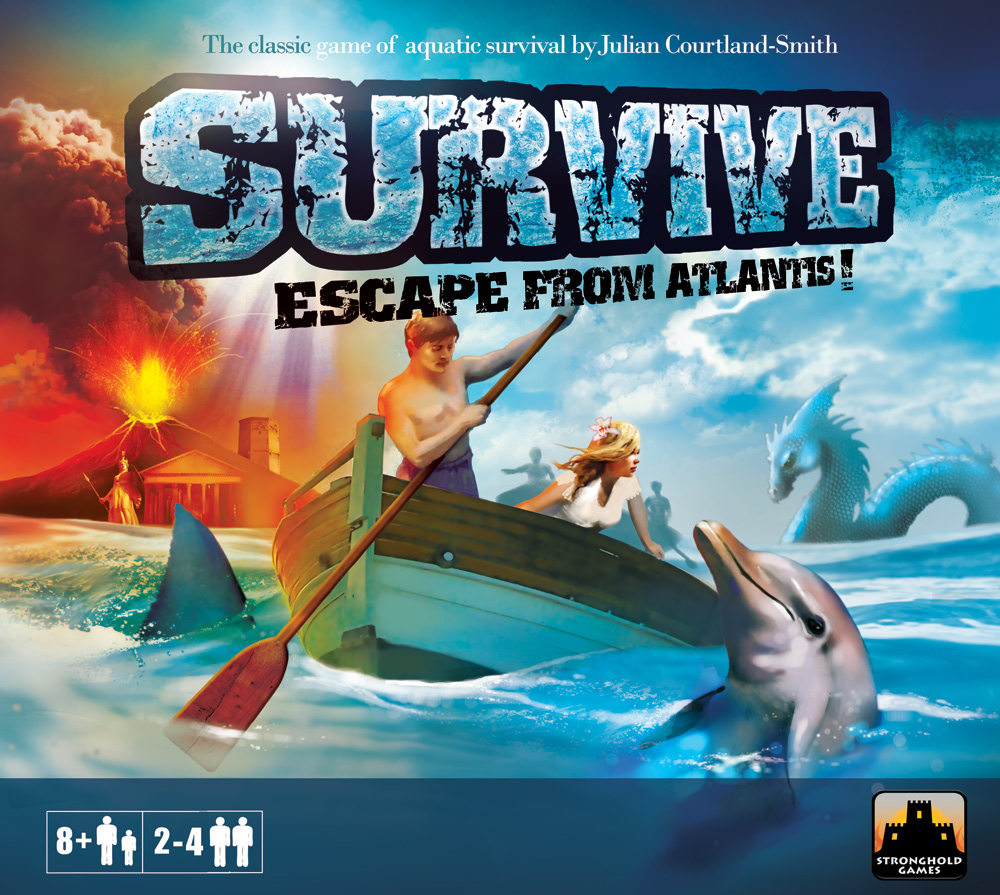
We've played this game a handful of times, and so far it's left a pretty good impression.  The first time I played it was a bit grumpy at first.  I was playing with people who had all played before, so I was the only newbie.  And when it came to the part where you decide where to place your men, this seemed extremely unfair as I had no idea of what the strategy was, and didn't know where to place them.  So I was grumpy for a few turns, certain that I would lose.  Well, needless to say there is definitely some luck in this game, and I'm not a terrible game player - I ended up winning, but aside from that I had a great time playing.

I like the fact that there is a good amount of luck and strategy involved.  It seems to be well balanced in that regard.  There are also a number of variations to the game which will probably keep it fresh (we've only played the most basic version).  I kind of hate to admit this, but I think this type of game favors me.  That's because it's easy for other players to go after who they think is going to win and sabotage each other, leaving me on my own for too long - long enough to get ahead and win.  I'm often underestimated and I find it works in my favor, at least with the people we play with (you'd think they would learn by now!).

I'm eager to play this one a bunch more times, but we were a little disappointed to see it wasn't widely available for sale online.  However, a new version is being released this month, so we'll probably be placing an order soon!

Sunday, June 3, 2012

Betrayal at House on the Hill


The thing that makes Betrayal an interesting game is that it is different every time you play.  It's also semi-cooperative, with a traitor later on.  There are really two main parts to the game: exploring the house, and then the haunt.  Players take on the role of someone exploring a haunted house.  Your character has stats (a number between 2 and 8) for speed, might, sanity, and knowledge.  Throughout the game you are asked to roll dice based on your stats.  These dice are special, though: each one has two blank sides, two sides with a one, and two sides with a two.  For example, if you have a might of 4 and you are asked to make a might roll, you roll 4 dice.  This means you could get anything between a zero and an 8.  In most cases you are trying to roll higher than a certain number that is specified on a card or elsewhere.

The first phase of the game you explore the house by drawing room tiles and "building" the house based on where you go and what tiles are drawn.  These rooms have symbols on them, and could be an event, an omen, or an item.  An event will cause something to happen and may result in you gaining or losing stats, an item is something that you can use in the future, and an omen is an object you hold on to that may do something good, something bad, or nothing at all when you draw it.  Every time an omen is drawn a haunt roll is made.  If the roll on the dice is less than the number of omens that have been drawn so far, the haunt begins.

There are 50 different haunts in the game, and the one you play is based on the last omen drawn and what room it was acquired in.  Once the haunt begins, everything changes.  One player is assigned to be a traitor based on a chart in the rules (it could be the person that reveals the haunt, the person with the highest knowledge, etc.).  They then do in another room to read their traitor rules, while the rest of the heroes read their own rules for the haunt.  Every haunt is different and has a different way the heroes win and a way that the traitor wins.  However, you only know your own objectives and rules - you don't know everything else about what the other side might be trying to do.

3-6 players.  45-90 minutes.  No expansions available.  Easy-medium learning curve.

Becky says:
I really enjoy Betrayal because it has a lot of what I like in a game.  It's got a cooperative element but the excitement of having a traitor, it's got some fun role-playing, and it's pretty unique in that the game is really different every time you play.  With 50 different scenarios, it certainly keeps the interest level up.  That's a lot of different ways the game can be played, and to me I think it's both the best and worst part about the game.

The good news is that the haunt part of the game rarely gets tedious.  Until you've played over 30 times you won't often get a repeat haunt that you've done before, and if you do sometimes you might be the traitor while last time you were on the other team.  Or if you're like me, the last time you played the haunt was a year ago and you don't remember any of it anyway (unlike Jason, who seems to remember every little detail of every haunt ever played).  And there are some really great haunts out there that are a lot of fun.  The best ones are when the game is close between the heroes and the traitor, and it goes on for a good amount of time without knowing which side is going to win until the very end.

Unfortunately, that's not always the way it happens.  When you have 50 different sets of rules and basically 50 different games, it's not surprising that not every single one of them is great.  There are some that are just not good.  But the bigger problem is that some haunts are great in some situations and terrible in others.  One haunt might be tons of fun in a 6 player game but a total dud with only 3 players.  And some haunts are better with a smaller house, while some are better with a bigger house.  If you get a haunt really early on the game or really late in the game, that can definitely affect how well the rest of the game goes.

We've probably played this game 40 or so times by this point.  There are still some haunts we haven't gotten.  But you know what can get a little tedious?  Building the house in the beginning of the game.  That part doesn't really change so much.  Sure, you may take the coal chute to the basement without meaning to, but for the most part it's pretty much the same all the time.  And with no real goal for that part of the game it can get a bit old.

But let's talk about another good thing: it's pretty easy to explain to people.  The first half of the game is pretty basic, and people catch on pretty quickly, especially since the first part is cooperative and you can sort of explain as you go along.  Once the haunt begins everyone reads and learns the rules together, and they usually aren't too hard since you're learning them mid-game.  Sometimes it takes a few plays to figure out the best strategies though.  In some haunts there is really only one strategy, in others there's a few ways to go about it.  Usually haunts like the latter are better because it makes it more interesting, and even if you lose you wonder what would've happened if you'd done it differently.

Overall I do recommend Betrayal.  The theme, atmosphere, and role playing aspect are great fun, and even if your haunt doesn't go so well sometimes that can still save the game.   I'll just say that it was a lot more fun when we first got it.  Now it seems to be more hit or miss.  But we've gotten a lot of use out of it, and still like introducing it to new players.  7.5 out of 10.

Jason says:
The following reading will be an exercise in the appropriate use of the word “but.”  You will see many examples of its proper usage in the correct context.  Pay attention for this in the recurring format, “Betrayal at House on the Hill is a good game, but…”

So… Betrayal is a good game, but it is also strangely unbalanced and… stuff.  The game is, at its core, a role-playing game.  It’s Dungeons & Dragons lite in many ways.  The game is built as you explore, and random encounters happen in each room, testing your character statistics in various ways.  There’s also a ton of information about the characters that you can use to “play your character” if the spirit moves you (and you are with those kinds of people).  Becky was frustrated by the story provided, suggesting there are large gaps in the explanation for why these characters are exploring a house.  I suspect that this instead gives players the freedom to make up their own stories, and that half of the fun of the game comes just from geeking out about the character development you and your friends can make up.
That stuff is nice and all… but… most people probably aren’t into that kind of stuff.  The game still stands on its own as a good game… BUT… many people might notice a certain role-playing aspect to the game that is extraneous, tedious, or downright boring (I’m in the role-playing camp, if I could just find people who aren’t too self-conscious to do it with me).

So… the gameplay is totally fun with its unpredictable nature… BUUUUUUUUUUUUUUUT, it is elementary and unbalanced.  The first half of the game is just setup, then the real part begins with one of 50 semi-randomly-chosen scenarios of varying difficulty, quality, and engagement.  So, 50 scenarios is cool… BUBUBUBUBUBUBUUUUUUUUUUUUUUUTTTTTTTTTTT!... the game setup is so random that these haunts can’t possibly predict the layout of the house, and thus the difficulty of the scenario.  Most of the time, it comes out either in favor of the traitor or in favor of the heroes, without question.  Sometimes, it comes down to a roll of the dice, or some other random factor.  Less often than I want, it comes down to an exciting duel between the forces of good and evil.  BUHUHUHUHUHUHUHT! when it does come down to that epic battle, this is a tremendous game.  When you play the game for the first time, regardless of the scenario, it usually feels like it works out this way, so somehow, the game manages to give a really good first impression.

For me, this game was really fun for a while, but I slowly realized that it boils down to the same die rolls with different role-playing disguises on them.  When that realization is made, no amount of scenarios is going to restore vitality to the game.

In the beginning, this was a really intriguing game to me.  8.1000000081/10.00000001  (8.1/10) but that is from the point of view of someone who hasn’t played as much as I have.  Keep in mind that I have played this game so many times that my wife and I together can’t count on all our fingers and toes combined (yes, 40+ times, I would reckon!) and after that much play experience, I would rate it a 6.5/10. It’s a good game whose beginning luster fades away the more you play it, BUTT!, after so many plays, maybe every game becomes exactly that: Butt.