Showing posts with label 2 players. Show all posts

Monday, January 21, 2013

Tsuro


Tsuro is a simple, easy to learn game using a board and tiles.  The tiles create a path for your marker to travel on.  The goal is to stay on the board, and not create a path that will take you off of it.  Whoever is the last one still on the board wins.

Players start with three different tiles from the stack.  These tiles have lines that will create various pathways.  The board is set up as a grid, and your tile must be played in front of your marker in a way that will progress it onward.  If your path intersects with a tile that has already been played, you must follow any paths that your marker comes across.  If the stack of tiles runs out you must wait until another player is eliminated to get another one.

2-8 players.  10-25 minutes.  No expansion available.  Very easy learning curve.


Becky says:
This game is super simple, and one of the best parts about it is that it is so versatile.  It makes a good "filler" game, that is, something that you can play if you're looking to pass just a little bit of time or if you don't want to dedicate a whole evening to board games (we often play in large groups where multiple games are going on at once, so we use filler games when one group is finished and waiting for the other group so we can decide on the next big game).  It holds anywhere from 2-8 players, and usually only takes around 10-15 minutes, though we've had games as short as 5 minutes and as long as 25.  It's pretty easy to explain as well.

Also, for a simple game, the artwork is really lovely.  They use some lovely colors, so instead of your typical red/blue/green/yellow pieces, you have gray, white, black, a dark red, a "caramel color," and a few others.  The dragon and phoenix art is gorgeous, I feel like it's something that I want to frame and hang up on my wall.

I personally feel that there's not a ton of strategy involved, and it tends to lean much more toward a "random" game where luck plays a big part.  That being said, there is still at least a bit of strategy, usually closer to the end of the game, to help you feel like you have a little bit of control in it.  In do encourage people to try not to strategize too much, because I think it can really slow down what is otherwise a quick game if players spend a long time analyzing each piece and trying to plan multiple turns in advance.

Overall I like Tsuro.  It's an enjoyable filler game, though it doesn't exactly blow me away in any way.   We've probably introduced it to at least 20 people by this point, and everyone that has tried it has enjoyed it - gamers, non-gamers, young, and old.  So I think there's something to be said for a game that appeals to such a wide group.  8 out of 10.

Jason says:
I've been on a bit of a kick for the smaller games lately.  The ones that don't have to be epic, intense, hours-long experiences.  Tsuro fits into the smaller category.  In fact, Tsuro may have the simplest learning curve of any game I've ever played.  Yes, it might be easier than Candy Land (because there's no counting of colored dots).

So, to recap the rules:  you have three tiles with winding paths on them.  Play one, and find out where your dragon stone goes.  Fly off the side of the board and you lose.  Be the last one in play.  I love it because a toddler could play it and enjoy it.  Even if someone can't fully comprehend the consequences of their turns entirely, it can still be a nice game with a refreshing pace and some very pretty artwork.
The whole game is over within ten or fifteen minutes, which means it definitely doesn't test anyone's patience.  Better yet, players still feel involved during other players' turns;  because of how dramatically any one tile can change the whole game, you are compelled to pay attention.

Now, there might be one criticism about the game: since every turn can have a huge impact, when more people play, it becomes chaotic to a point where it all seems based on how lucky your path is.  However, I don't think that is so, because sometimes it's just about watching the chaos unfold and having a good laugh about the crazy things the pieces do on their way off the edge of the board.  Sometimes it's just about following your path.

What can I say negatively about the game?  Well, I haven't decided if this game has a lot of replay value or not.  With fewer people, you do get more turns, but it is easy to fall into a defensive style and just try and avoid your opponent.  If this happens, you each just spend most of the game wandering around until the very end, when either you die or you don't.  If you are competitive and you try to actively thwart your opponent, it can be a little better, but then again it could still be frustrating how little control you can wrest from your opponent.  Moral of the story is this: the game is for fun, not to compete.  If you play this game just to win, then you've already lost everything valuable this game can give.

Oh, one more thing: I love how easy it is to take a conversation about the game and turn it into something philosophical, like "you must follow your path, wherever it goes," or "our paths meet, and I am in your hands now" or "the path will always end once all the tiles are played, and you should only hope to stay on the board as long as you can."  Yes, these are pieces of conversations I've actually had about the game, and for that alone, I think this game deserves some credit. 7.5/10 worth of credit.

Tuesday, July 3, 2012

Citadels

Citadels is a card game in which you collect gold in order to build "districts."  Each district costs a certain amount of gold.  The game ends when one person has built 8 districts, and whoever's districts are worth the most (including some end of game bonuses) wins the game.  Every turn you have the option of either taking two gold pieces or drawing two cards and keeping one.  You then have the chance the build a district.  Then your turn is over and it's on to the next person.

It sounds pretty simple, right?  Well, the twist comes in with the roles/characters.  There are 8 characters, each with its own special ability.  The thief can steal gold, the merchant gets a gold bonus, the architect gets extra cards, etc.  The cards are passed secretly around so that you can select your role - and try to guess what the person before you took, and what the person after them took.  It's not as easy as it sounds to pick a role.  If you want more gold, you'll be tempted by the merchant - by the assassin might want to prevent you from getting that gold and will kill the merchant.  It's all about strategy, and who you pick can make or break the game.

2-7 players.  45-60 minutes.  Dark City expansion available.  Medium learning curve.


Becky says:
For some reason, Citadels tends to fly under my radar.  I'm never dying to play it, and I don't think I'd ever suggest it, but if someone else suggests it I'll definitely play.  I just tend to forget about it, mostly.  It is a fun game, it just isn't a stand out for me like some of the others that we've played.

Our group tends to have a rather large problem that others might not experience, and that's how much downtime there seems to be.  We play with many people that really take a lot of time to strategize and plan out exactly what move they're going to make.  The process of choosing what role you want and then pass the cards around can take over 5 minutes for us.  I've heard from other people that their games don't take nearly this long, so this might only be a concern if you know you play with a group of people that like to take their times with stuff like this.  Also, once the round begins, you take your turn one player at a time, and the majority of other players turns don't affect you, so there's some down time there as well.

But on to the good things: it does take some interesting strategy to try and win the game.  If you want to do well you'll be tempted to take the more powerful characters, like the merchant, who gets plenty of extra gold.  But the powerful characters also have a big target on their backs, so you can be sure the assassin and the thief are after them.  You not only have to make good decisions for yourself, you have to predict what you think your opponents will do and how it will affect you.  And they're doing the same thing, so they might do something different than they normally would if they're thinking about what you're doing.  It's definitely a game where it helps to know your opponents and their style of game play.

One other comment - the two player version of this game is a big flop, in my opinion.  Even though they try to change the rules up to make it less predictable, it doesn't really work.  You can still tell pretty easily what your opponent has chosen.  Plus, the person that goes first seemed to have a gigantic advantage and pretty much controlled the game.  I wouldn't bother with it if you've only got 2 players.

Overall, we play Citadels infrequently enough these days that I enjoy it when it does come out, but I'm never dying to play it.  It's good when we need a change from the regular games we've been playing.  I'm also surprised to find out that Jason enjoys it much more than I realized, as you'll see below.  As for me, I give it a 6 out of 10.

Jason says:
Citadels.  It's a game.
Yep.
It's one of my favorite games, actually.

What stands out about this game is the characters and how much sway their powers hold.  Picking the wrong character can cost you a turn, or all of your gold, or a large portion of your points, maybe a combination of the three.  So basically, the stakes are really high every turn.

Also interesting is that it isn't a matter of numbers or excellent strategy, it's actually a matter of understanding your opponents' motivations.  When you lose your gold, it's because someone else decided to steal from your character; tough luck, you might've avoided it had you considered that that person would steal from the character you picked.  Lots of people suggest that they just have rotten luck playing this game.  However, I say that luck really isn't much of a factor in this one.  Instead, it's about figuring out what everyone will do and how you can maximize your profits from the way things will go.  The strategy eludes lots of people, and lots of other people just don't want to put forth the effort to think things through.  Of course, flying by the seat of your pants is a legitimate strategy, but if you're playing with someone who is really attentive, it is also a losing strategy.

So my short description of the game's great qualities is this: the strategy is person-centric and relies only a little on luck; any single turn in this game is high-stakes, giving the game an extra sense of intensity; the game is simple to learn, but monolithic to master.

Citadels has drawbacks too, and one of them is that some people will be intimidated or discomforted from the intensity of the game.  Some people show this through nervousness, while others simply fail to see why it is so intense.  The game is not for everyone.

So, when playing with those kinds of people (the people that this game isn't for) you get several phenomena; they get distracted during character picking, or they stop caring because they don't "get it."  Unfortunately, this brings the game down for everyone, because it's such a person-centric game.  I'll admit, it feels like a slow game, but it will only feel slow if you fail to see the value of paying attention to the important decisions.

This was a tough review, because no words can truly describe what it feels like to play a good game of Citadels.  I will give Citadels a 8.8, and that is out of a possible 9.999995, but since 99.99995% (also known as 5σ) is good enough to declare a discovery in high-energy physics, it's as good as a 10 for me.  So, 8.8/10.

Monday, May 7, 2012

Battle Line


This two player card game is a competition to see who can win the most “flags” in this war.  You start out with a row of 9 flags, and players take turn laying down cards on their side of the table.  The cards range from 1-10 each in 6 different colors.  Once three cards have been laid by each player on one flag, that flag is complete and you see who won.  The best combination of cards you can get is a straight (8,9,10) all of the same color.  Then three cards of the same number but different colors, a straight of different colors, and so on.  Whoever has the better set of cards claims the flag.  You can also claim a flag on your turn if you can prove the other person can’t possibly win it no matter what cards they play because of what is already out on the table.    The game is over once one player has claimed 5 flags, or if they claim three flags that are next to each other.

What makes the game a little more interesting is the tactics cards.  These can be played on a turn instead of a regular card and have special effects, such as being a wild card or requiring a flag to have 4 cards on each side. 

2 players.  Approximately 30 minutes.  Easy-Medium learning curve.

Becky says:
It’s nice to have some good two player games for when our friends and family aren’t around and it’s just Jason and me.  Previously the only two player game that I had which I really enjoyed was Lost Cities.  Battle Line has a similar feel to Lost Cities but it’s a bit more complex, which I like.  It’s by the same designer, Reiner Knizia, who I’m a really big fan of.  I didn’t think much about designers/companies before, but now that I have experience playing  a wide variety of games I am starting to notice that I favor some designers over others.

There is a bit of luck involved here, but it’s really a lot about the strategy.  If you have several 9’s or 10’s, do you lay them down for the three of a kind?  Or do you try to build up for the more powerful straight first?  The game can also turn very quickly.  You might start out with some good cards, but if you don’t play them right you’ll probably lose.  Another common mistake I’ve noticed is that you don’t want to commit yourself to one thing on one flag, so you spread out all of your cards on different flags.  Then, if you get something that doesn’t fit with what you’ve already played, you have nothing left to do with it.

I think the most complicated part of the game is flag claiming.  It’s up to you to figure out when you can claim a flag, which means you have to be aware of everything and watching like a hawk.  This makes the game more challenging, but in a way it’s frustrating too.  Since you have to watch everything and contemplate every move carefully, it can drag the game out – especially when it’s not your turn, it’s easy to get bored.  I am also too honest of a person sometimes.  I feel badly if I see that my opponent can claim a flag but they haven’t realized it.  Sometimes I tell them.  Maybe I am too honest for this game, but I rationalize it by saying, “It’s the first time they’ve played” or “the second time they’ve played.”  How many plays do they get until I stop feeling badly?  I’m sure there’s a cut-off somewhere, but this game is still too new for us to be there yet.  But that is more of my own personal flaw then the game’s!

Overall I really enjoy this as a two player option.  Although it can feel long depending on who you’re playing with, it actually doesn’t last that long and it involves some really good, complicated strategy, which many two player games seem to lack.  I give it an 8 out 10.

Jason says:
I am finding it difficult to rate Battle Line because I don’t categorize two-player games the same way I categorize group games.  For one, I don’t like two-player games as much.  For another, I like to think of group games as sort of special events; I would call up a group of friends to come play games like Carcassonne, Bang!, and Dominion, but I wouldn’t call up a friend to visit just to play Battle Line, or Lost Cities, or Balloon Cup, et cetera.  Maybe it’s just a mental block that I need to eventually get over, some hidden prejudice against two-player games.

It’s a good game with good gameplay.  I suspect that, much like Chess, there are good opening moves and there are bad opening moves, and these are things that a player just has to experience (or maybe read about) to get a feel for what works and what doesn’t.  As the game goes on, it becomes a lot clearer how the pieces have fallen, and it really comes down to seeing whether or not your early-game preparations will see you through to the end (with a little bit of luck drawing the cards).

The game is lots of strategy, but it is also some luck (the kind of luck that is still strategy because you can still pick the “more likely” lucky outcome).  I like that.  I also feel like this game is the spiritual relation to another game, Lost Cities.  It plays the same sort of way that Lost Cities does, with each player playing unique cards on their sides and sometimes being forced to play cards they don’t like.  Except Battle Line takes a longer time getting there and just seems generally harder to comprehend.

So I’ll suggest this: I am not fond of games that have a high level of “obfuscation.”  By that, I mean that if I’d rather read War and Peace or read Ulysses than read the rulebook, that’s bad.  If the rules are about as intuitive to my experiences as quantum physics is to the Classical Model, that’s bad.  If I liken the game to Rube Goldberg machines, that’s bad.

Why is this game a Quantum Rube Goldberg Machine with an instruction manual written by James Joyce?  Okay, that’s a gross exaggeration.  But even though it’s a good game, there are games out there that do more for me, and do it better.  Lost Cities plays the same sort of way but is far less confusing, goes faster, and is still skillful.  If I wanted a hyper-strategic game that makes even my brilliant brain itch, I’d go with Chess.  Lastly, if I wanted to make pretty matches of cards, I’d play Rummy.

For now, I’ll give two-player games a different rating system, until I can come to terms with two-player games and (n>2)-player games in the same space.  Battle Line gets a B grade from me.  I guess now is the appropriate time to say this: I’ve never once earned a victory in this game.  I did technically win once, but it’s because the other player was distracted.  And I failed to clarify a fairly pivotal rule before it became pertinent.  And it was a pity-rematch anyway.

Tuesday, March 27, 2012

Dominion

This is a deck-building card game in which players attempt to earn enough points to be the others.  Everyone starts with a basic hand of 7 copper coins and 3 estate cards (worth one point each).  Each turn you play off of your own individual deck.  The turn begins by drawing five cards.  You then have an action phase, in which you can play action cards.  Then there is the buy phase, which allows you to purchase new cards to add to your deck – these might be action cards, money cards, or victory point cards.  Finally, you end your turn by discarding all cards played and any that still remain in your hand into your own personal discard pile.  You immediately draw 5 new cards from your deck to prepare for your next turn.  When you run out of cards your deck gets reshuffled.  The game continues in this manner until either all of the province cards are gone (victory point cards worth 8 points) or when any other three stacks of cards have been exhausted.

2-4 players.  Multiple expansions and other stand-old versions available.  Approximately 30 minutes.  Easy-medium learning curve.

Becky says:
One nice thing about this game is that the basic rules are simple enough.  The variety of different action cards can make it seem a little overwhelming, but once you accept that you’re just going to have to take some time to read the cards and get to know them, the game can go pretty quickly.  One thing that I really like is how the playing experience can be different every time, depending on what cards you use.  There are pre-set arrangements that they recommend, but you can also just randomly select which cards will be played with for each game.

One thing that is both a pro and a con is that it can be very difficult to figure out what strategy you want to use, and that can change depending on which cards are used.  Many people I play with build up these amazing chains of action cards, going through almost their whole deck in one turn.  Somehow I just can’t get that strategy to work for me.  I find that if I’m buying action cards it means I can’t upgrade my coins, and if I have mostly action cards I don’t have enough coins to buy what I want anyway.  It’s a delicate balance that you have to find. 

I also love how fast paced the game is.  It’s not like Citadels, where I feel like we wait forever for everyone to make their selections, or even Bang!, where a turn can drag out for far too long.  I know Jason will complain that this game doesn’t move quickly enough for him, which frankly I don’t understand.  I find that half the time, by the time that I have drawn my cards for my next hand and figured out what I want to do with them, it’s already my turn again.  I will note that we don’t own this game, his brothers do, so we only play when they come over which means that it’s always a 4 person game.  It would be interesting for Jason to try 2 person Dominion and see if that fixes his issue with the pace.

While Dominion is a very good game, if I have to note some negatives I will say that it doesn’t always seem perfectly balanced, especially when you choose which cards to play with randomly.  Sometimes it feels like you are getting nowhere fast, so you might as well start buying Duchys so you can get some points.  And while I don’t have a problem with the general idea of the attack cards, some of them seem much worse than others and a few I personally feel are too harsh or annoying and don’t really add much to the game.

Overall I enjoy Dominion, but probably not as much as I could because Jason usually is resistant to play, and what fun is it to play a game when one of the players isn’t into it?  I still give it an 8 out of 10 as it’s a fun game and I am pretty much always willing to play it.

Jason says:
I was really fascinated with Dominion the first time I played it.  It was like a breath of fresh air.  It’s another one of those solitaire-feeling games, where you play your game, other people play their game, and (except for a few exceptional cases of indirect influence) everyone compares their work at the end of the game.  In my mind, I put it into the same style class as 7 Wonders.

Like Bang!, Dominion fills a void in my gaming heart that was once reserved for collectible card games.  Bang! fills the game playing part, but Dominion appeals to the deck-building fun.  Yes, a lot of the fun that people find in collectible games like Magic: The Gathering is the search for the perfect deck design.  Dominion knows this, and it turned that search into a game in and of itself.

Regretfully, the more I play Dominion, the less fond of it I have become.  It is fast-paced, especially for a game that goes by turns, but I still get impatient waiting for people to take their turns.  Normally I have the patience of an immortal, but Dominion just hits some spot in my brain that can’t seem to wait.  That complaint might just be my personal problem, so I think others should judge for themselves on that; let me know what you come up with.

My real gripe with the game is the Attack cards, the part that makes people interact more directly.  Because the game feels like such a personal endeavor, attacks and disruptions feels contrary to the spirit of the game.  Also, they make the game slow down more.

I rate it a 6.6/11, which really just comes out to 6/10.  Even though it is one of the lower scores I have given and despite how critical I am of it, I do enjoy playing it, and there are many times I would rather play Dominion than games like Pandemic or Bohnanza.  I will point out that almost everyone I play games with disagrees with how low a score I gave to Dominion, but because of how impatient the game makes me, I'm sticking with my decision.

Monday, March 19, 2012

7 Wonders

This is a card game in which each player is working independently to create their own civilization.  You start off with a hand of 7 cards, of which you can pick one to build.  The rest get passed to the person next to you.  You usually start by building resources, which are often free, and then you have to use resources to pay for bigger things you want to build later.  There are also ways to earn coins, which can help you pay to build cards.  There’s a variety of different card types of build, and it is often good strategy to pick one or two card types of focus on that.  They include military, civilian structures, commercial structures, scientific structures, and guilds.  The game has 3 rounds, and at the end you add up the points that your structures are worth and whoever has the most points wins.

One other aspect of the game is your wonder.  There are seven different ones, and each one has different rewards on the bottom.  At any point during the game instead of playing a card you can choose to build a level on your wonder and get the reward for that.

2-7 players.  1 expansion available (Leaders) and one coming out soon (Cities).  30-45 minutes.  Medium learning curve.

Becky says:
For one reason or another, I was a little bit hesitant about trying this game, and didn’t really care for it the first time I played.  All of the different cards just seemed so overwhelming, and I was playing with people that had played several times before.  I didn’t even understand what those “green cards” were, and so I ignored them – while other players were getting 30 points from them!  When it comes down to it, though, I really enjoy the game after playing it more.  It is very similar to other card playing, point gathering games, such as Race for the Galaxy and Dominion.  While I am not great at those games I really like them.  I think one of my favorite things about such types of games is that it doesn’t feel as competitive as other games.  You are working on your own little thing and not caring what other people do very much, except maybe when passing cards or building military structures.  That’s not to say that you shouldn’t pay attention to what other people are doing – that’s a good way to lose the game.  But it’s not usually your main focus.

Another plus – I really love the little scoring pad.  It seems like such a simple thing, but it helps a lot for tallying up the points at the end.  Speaking of scoring, while some of the areas are straightforward in terms of scores, other ways to gain points are a bit more subtle.  Science, for instance, is probably the trickiest type of card to go after.  Military is somewhat straightforward but the results can vary greatly depending on what the person next to you is doing.  I like the fact that there are different ways to play the game.  I often alter my strategy based on which wonder I get, which makes the game fun and a little different every time.

The biggest downfall for me is that sometimes you just can’t get the right cards.  I was stuck in a game once where I built the resources I thought I would need, and then it turned out there were a few other things I needed later on – which neither of the people next to me had.  So I just went turns where I couldn’t build anything at all, or had to build pathetic little things.  Those games are very frustrating, though that may just be bad luck.  You also have to keep in mind that the game changes based on the number of people playing.  If you have less than 7 you remove cards from the deck.  If you’ve played a lot and have specific cards in mind that you might be searching for, it can be difficult to remember which ones remain in play with fewer people.

Overall I give the game an 8.5 out of 10.  I enjoy playing it a good deal but it doesn’t quite make it to my list of favorites.

Jason says:
Before having played this game, I had been exhausted of all of the "point-scoring" games out there because it had become a stale mechanic to me.  Ticket to Ride, Carcassonne, Master's Gallery, tons and tons of other games out there are just mathematical processes (these are all games that we will review some day).  They just bored me (I'll also talk/rant about that some day).  But when 7 Wonders came around, it was unique, it was entertaining, it was complex, and most importantly, it was just plain fun.

One of the best parts of 7 Wonders is that everyone takes their turns at the same time.  Fast thinkers and impatient people can breathe a sigh of relief when they play this game, because every turn is your turn.  On a turn, each person selects a card from their hand, then everyone plays their selected card simultaneously.  When you have seven people playing the game, that's seven turns for the price of one!  For comparison, imagine how long it would take if seven people all played Carcassonne.

Alright, so far, I've given this a pretty good review.  What's the catch?  Glad you asked.  The learning curve is steep and high.  Someone playing for the first time shouldn't expect to know what they're doing at all.  You can have an expert teacher who can literally insert information directly into your brain, but you won't completely understand what a good strategy is until you play the game through once.  Maybe even several times, depending on 1) how experienced you are with games in general, 2) how genuinely interested you are in trying to learn the game, and 3) what hints your teachers give you through those playthroughs.  The game is great though, provided you stick it out for that first game.  or five.

So I think I'll give this game a 2.7/3, but of course, if you run through the math, 2.7/3 is exactly the same as saying 27/30, and if you divide both the numerator and the denominator by three, you end up with a 9/10.  So there it is.  9/10.  Or a grade of 90%.  Revel in this, because not many more games will get the "A" rating that I've been giving out lately.

PS: Yes, I know that Carcassonne only holds up to five people.
PPS: If you've never played Carcassonne, then just substitute your own experience with a game that's wretchedly long because everyone takes their turns separately.

Sunday, March 4, 2012

Bohnanza

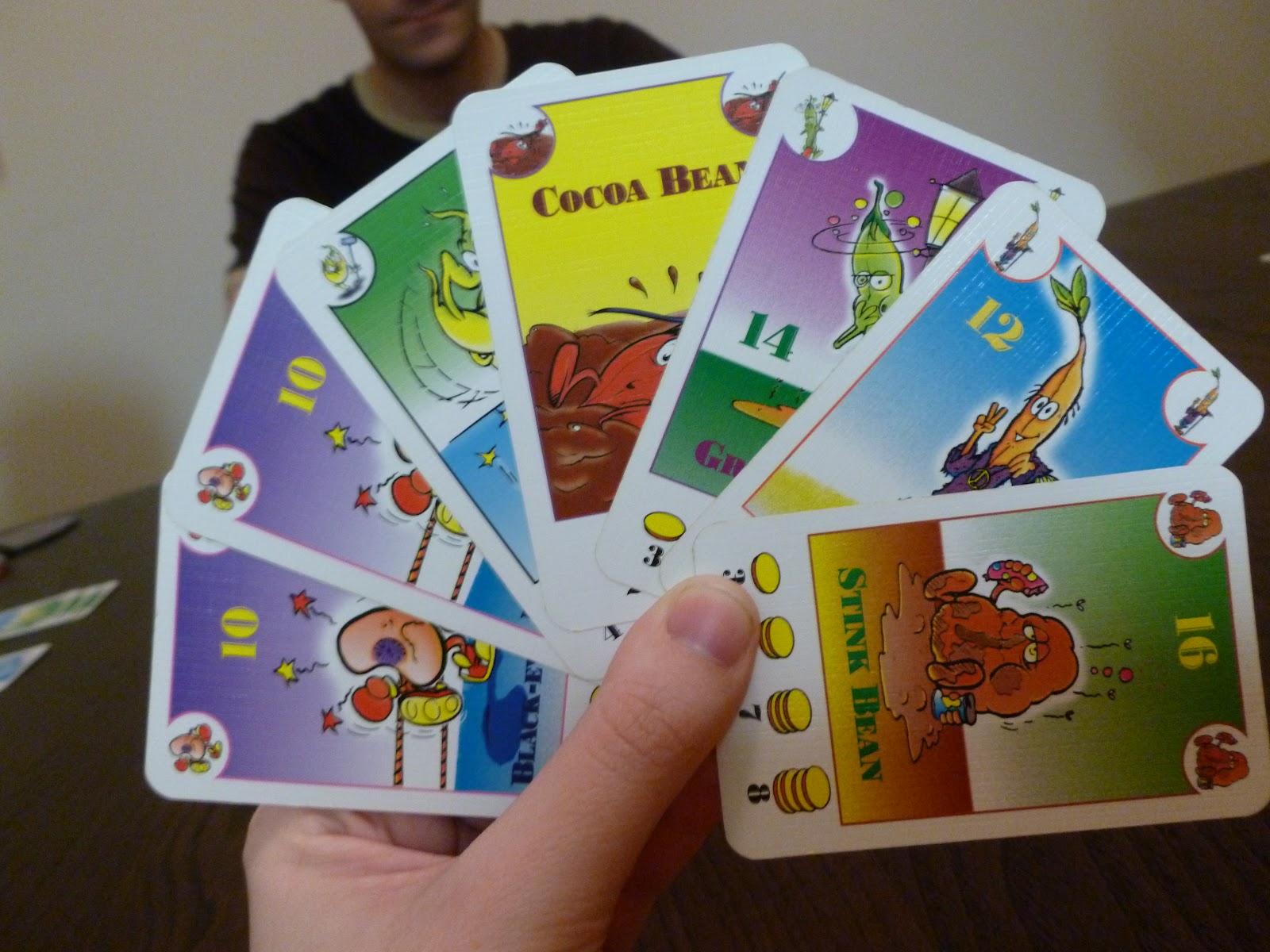
In Bohnanza, you are a bean farmer.  Your goal is to grow beans in order to gain coins, and have the most coins by the end of the game.  There are a different types of beans in the deck, and each bean has a different number of cards in the deck.  For example, there are 22 wax beans in the deck, but only 4 cocoa beans.  In order to make money off of your beans you need to plant a certain amount of them.  For more common beans, such as wax, you need to plant more than you would for the rare beans such as cocoa or garden beans in order to get a good pay-off.  When you are ready to plant different beans, you dig up the ones you have and earn the coins from that.

You start with a hand of cards, in which order matters.  That means that however you pick the cards up is the order in which you must play them – you can’t move them around within your hand.  You have two fields in which to plant beans.  At the start of your turn you must plant the first bean in your hand, and you may plant the second one if you want.  You then flip over two beans face up from the draw pile.  You can choose to plant these beans , or you can trade them for beans you actually need.

What this game is really about is the trading.  You can trade what you turn face up, but on your turn you can also trade from out of your hand.  There aren’t many rules about trading – almost anything goes.  The only major rule is that when you trade, you must plant the bean that you get, you can’t just put it into your hand.  Trading from your hand is a good way to get rid of beans that you don’t want that are in your way.  You go through the deck three times, and at the end of the game you count up the number of coins you have from planting beans – the player with the most coins wins!

2-7 players.  Multiple expansions available (Bohnaparte).  Approximately 45-60 minutes.  Easy-medium learning curve.

Becky says:
Bohnanza is a fun little game, and pretty easy to get the hang of quickly.  The cards and brightly colored with cute pictures.  In terms of game play, I do like it.  I wouldn’t say it’s my favorite game, but it’s fun.  It’s a very social game, as you are constantly trading or bargaining with people. 

I think the trading is fun, but it certainly depends on who you play with.  You also tend to develop certain “types” of traders, which I’ve developed names for.  There’s the “Too Nice” trader, who will give you the beans you want even if you can’t offer anything in return.  This person tends to go with the line, “just remember it for next time!”  Then there’s the “Miser,” who doesn’t want to trade anything that will help anyone else – unfortunately, that often puts them in a bad position but they’re usually too stubborn to act any other way.  And there’s also the “Bargainer,” who is constantly trying to get a better deal.  “A wax bean for a blue bean?  I could do that, but how about you throw in a stink bean too?”  This person can get very greedy and frustrating to trade with.  It is interesting to see how your friends and family act when it comes to trading beans!

On the negative side, this game can get really long and slow moving if you play with too many people.  This is especially true if the people you play with are stubborn – “But I don’t want to plant this blue bean!  Won’t anyone trade with me?  No?  Well, I’ll keep offering different trades for the next ten minutes anyway.”  The game holds up to 7 but that can often be way too long.  It’s a fun game, but most people don’t really want to be planting beans for 2 hours.  I find it works really well with 4 or 5 people, especially if they already know how to play.

In the end, it’s not a game I want to play all the time, but I enjoy it every once in awhile.  I don’t feel it’s particularly outstanding in any way, but it’s just fun with a little bit of strategy.  And sometimes, you don’t need a crazy, complex game – you just want that game that lets you have a good time without too much effort but still requires a little brain power.  Bohnanza fits that niche well.  7 out of 10.

Jason says:
Bohnanza.  Here I am, an American writing a review of a game by the German publisher Rio Grande games.  I always liked that about this game.  It has nothing to do with the review, but I thought I would share that.

Interesting game, certainly another unique one, which I say because I haven’t seen another game that does quite what Bohnanza does.  The game is simple; you plant beans, you dig up beans, you get money.  Your friends are also doing that.  The trick is that everyone wants stuff that everyone else has.  So it’s really a game about trading in a way that makes your hand work as well as it can, which can be especially difficult since the order of the cards in your hand matters.  Yes, a stink bean in the back of your hand could be just the trade leverage you need to secure your new bean farm, but a stink bean in the front of the hand could spell disaster for your hard-earned bean empire, a situation that most often just… well… stinks beans.

Alright, so what about the game?  Extremely social and interactive, that’s a plus.  And it’s easy, that’s a plus too.  I would also venture to say that winning the game isn’t nearly as fun as just playing it, which I think is a big point in its favor.  Of course, with any social game, it matters who you play with, and it’s important not to get hung up on people making strange trades that you think don’t make sense: there’s no rule that they aren’t allowed, and you have no idea what kinds of beans are cluttering up their hands or how desperately they want to trade that clutter away.

Now, having said all of that, this game is a good one, but it’s not one of my favorites.  I don’t get excited when someone says, “Let’s play Bohnanza!” but that is just my opinion.  I think of it as one of those change-of-pace games for when we’ve played tons of Pandemic and Bang! and such.  Like any game, it has its deficiencies.  It can drag a bit if people aren’t focused or if the trading gets too involved.  There may also be a person or two who simply can’t get their bean machines working because that’s the way the cards are dealt.  But I think these small deficiencies fade compared to the positive simplicity and elegance of the game.

Now, I think I will rate Bohnanza at 425.02/538, or a 7.9/10 which means that I rated it higher than Pandemic or Lord of the Rings.  But you see, when I play games, Bohnanza doesn’t really come to mind, even despite how much I like it.  I think of Bohnanza as that guy that everyone thinks deserves better, but no one really wants to throw him a bone because they think they have better things to do.  Maybe it’s just old hat for me at this point.

Thursday, February 23, 2012

Lord of the Rings

This strategy game is based on the books, and not the movies.  It is a fairly complex cooperative game, in which up to 5 players can participate.  Players take on the roles of Frodo, Sam, Merry, Pippin, and Fatty (a minor character from the book) and each have a special power, which they must use to work together to destroy the ring.  They have to get through 4 different boards in order to do so (Moria, Helm’s Deep, Shelob’s Lair, and Mordor).  Players begin a turn by drawing a random tile, which will usually either move them up through the board they are on or make a negative event occur.  They then can play up to 2 cards to progress further through the tracks on the board, choosing strategically which tracks to move up and which cards to hold on to, taking into account the events that could occur later on.  In the meantime the players characters are on a separate track which has Sauron at the end of it.  Various events and die rolls can cause either the players to move closer to Sauron or Sauron to move closer to the players.  Meet Sauron and you’re dead – and if the ring bearer meets Sauron the game is lost.  Victory is achieved if the ring bearer reaches the end of Mordor and is able to successfully destroy the ring without dying.

2-5 players.  Multiple expansions available (Friends and Foes, Sauron, Battlefields, The Black Gate).  Approximately 60-90 minutes.  Medium learning curve.

Becky says:  
This game has definitely grown on me when we played it more.  To begin with, it’s really hard to beat.  We’ve probably played 4 or 5 times now and won twice – but we’re still playing on “introductory” mode, which gives us a bit of a handicap.  I honestly thought this game screwed you over more than Shadows over Camelot ever could and it would be impossible to win.  The really cool thing was continuing to try it and discovering all of these strategies that occasionally work that I never would have thought of.  For instance, there have been times where we’ve just decided to take all of the negative events to get through a board as quickly as possible just to end it and hold on to our cards for future rounds.  In 5 player games we’ve also taken to making Fatty the “mule,” whose job it is to stock up on cards and give them up when necessary, usually spending his turn just drawing more cards.  I love that the strategy isn’t always obvious, and it definitely changes depending on how many people are playing.

It’s a game where working well together is really important, but everyone really has to be involved (unlike what happens sometimes with Pandemic).  Somehow, though, Lord of the Rings lacks just a little bit of the suspense and excitement that we get with Shadows over Camelot.    I’m not sure why that is (maybe the lack of a traitor?), but I haven’t quite found myself literally jumping out of my chair or pacing the room like I have with Shadows.  Lord of the Rings might be somewhat more enjoyable if you won more often, but that’s all part of the challenge.  I do like the fact that you get a score even if you lose, so you can still keep track and try to beat your previous scores. 

It’s also worth mentioning that the artwork on this game is really gorgeous.  Being geeks, we love the theme and the fact that it’s book based instead of movie based.  And we always enjoy a good cooperative game.  8.5 out of 10.

Jason says:
 I read somewhere that when The Lord of the Rings came out in 2000, it was a unique game because it didn’t pit the players against each other, it made them cooperate to beat the game itself.  It’s now 2012, so I guess I’m a bit late to the party, but that’s okay, because it’s still a really good game.  I’ve seen several cooperative games I think I like better, but variety is the spice of life, so this game has a place in my collection.  Also I am a fan of Tolkien’s books.

This game is extremely difficult, so it is rewarding when you can actually win.  Teamwork and discussion is mandatory, and sometimes even the best strategy is simply destined to fail.  Players have to seize every opportunity they can in order to have a chance at winning.  Everything is pretty straightforward and very linear, so it isn’t hard to learn, as long as you are willing to play through the first time knowing that one personwill have their nose buried in the rules figuring things out.  You could also play with someone who already knows the game.

I don’t have much to say about this game, besides that you should play it for yourself; that is a positive endorsement by the way.  Remember that I do endorse this game, because there are a few issues that I do have to point out.  The first is that this game is pretty static, and once you’ve beaten it, that’s it.  There are multiple difficulty levels, but like I said before, it’s extremely linear, so it is pretty much the same game every time.   The second issue is that there are a bunch of little nuances in the rules, and they’re important.  The worst part is that they are scattered all throughout the giant tome they give as the rules.  The rules aren’t very orderly and I’m still not sure I know every little detail there is to know; for example, we didn't know that the ring-bearer draws two cards at the end of every conflict (remember that, that’s important for winning, and lots of people miss that).  My third problem is the same participation problem that plagues Pandemic; it’s easy for a quiet person to sit back and think that everyone else is handling the game.  But then again, maybe communication is one of the skills you can attribute to “being good” at this game.

It doesn’t seem like I said many good things about this game.  But don’t be fooled, I really like this game and I think it’s worthy of anyone’s collection, especially those Tolkien fans (the game is based on the events in the books, not the movies).  As far as I know, it is the father of contemporary cooperative board games.  Also it was designed by Reiner Knizia, who is one of the most well-known and reputable game designers out there.  I give this game a 9.23/13, or a 7.1/10, and that means that I like this game just a smidge more than Pandemic.  So if you’re a savvy board gamer, try this, then try Pandemic.

Monday, February 6, 2012

Pandemic


Pandemic is a cooperative board game in which you are trying to rid the world of several killer viruses.  Your goal is to cure each virus by collecting 5 cards of the same color.  Each turn players will get the chance to move around and fight the disease, cure it, or trade cards.  However, they must also infect several more countries at the end of each turn.  Players much strategize together in order to be victorious.  They are also each assigned a character with a special ability to aid them in their goal.

2-4 players.  Expansion Available (On the Brink).  Approximately 60 minutes.  Easy-Medium learning curve.

Becky says:
I really enjoy cooperative games, so Pandemic gets points for that.  However, it’s definitely not my favorite out of all of the cooperative games we’ve played for a few reasons.  The first is that the game kind of lends itself to one person “taking over” and directing everyone else, rather than allowing individual players to make their own decisions.  This may also be a result of the type of people we sometimes play with, and if new people are slowing the game down.  The other thing I don’t really care for is the fact that the game can end really quickly if you draw the wrong combination of cards. 

But on to the positives!  I really like the fact that there are three different ways to lose the game – if you run out of cubes of one color, if 8 outbreaks occur, or if you run out of resource cards.  Of course I don’t like losing, but I feel like that really keeps you on your toes and makes you strategize in more ways than one.  I enjoy the different roles that you can be – the medic is definitely my favorite.  And when you really get into the game, it often comes down to just a few moves that are the difference between winning and losing.  That’s really exciting and full of suspense, a feeling I love when playing games.  Another really nice thing about Pandemic is that it is relatively easy to learn, so it’s a good “gateway game” if you want to introduce people to this sort of strategy game.  7.5 out of 10.


Jason says:
I think cooperative games are my favorite kind, so I was already partial to Pandemic going in.  That said, the game still stands on its own merit, being a fiercely difficult but satisfying experience.  The gameplay is logical and the “right” move can often be reasoned out, though “right” is hardly ever obvious.  There is a small but influential bit of chance, which I think is a good proportion (too often, games either have too much chance and you have no control, or too little chance and the game is nothing more than a process).  Pandemic is logic with enough uncertainty that it feels like the meeting of a board or an action committee where they lay out their options, discuss the ramifications, and agree to meet again next turn.  Almost a simulation, but the difference between Pandemic and a meeting is that Pandemic is fun, and action committees, not so much.

My biggest gripe with the game is the participation problem.  It’s easy for first-time players or introverted people to be lost in the waves of discussion.  They might think that other people are getting it, so they don’t need to contribute.  But contributing to the discussions is the bulk of the game, so that person ends up feeling like a placeholder, a potted plant with cards.  Then again, the game suggests two ways of play: you can show your cards to everybody, or you can’t but you’re allowed to say what you have.  At first we thought that not showing cards was silly, but since we’ve played more, I think that hiding your cards encourages you to speak more, thus encouraging you to contribute.

Ultimately, I think I’ll give it a 9.1/13, or for the less mathematically inclined, 7/10.  It encourages highly logical thinking and can get pretty intense, but the participation issue does turn some people off to the game.  There is an expansion, which I think improves the game.  Eventually we may do a review of the expansion, which I have no doubt will have a higher score from me.