Showing posts with label card game. Show all posts

Thursday, August 9, 2012

Poison


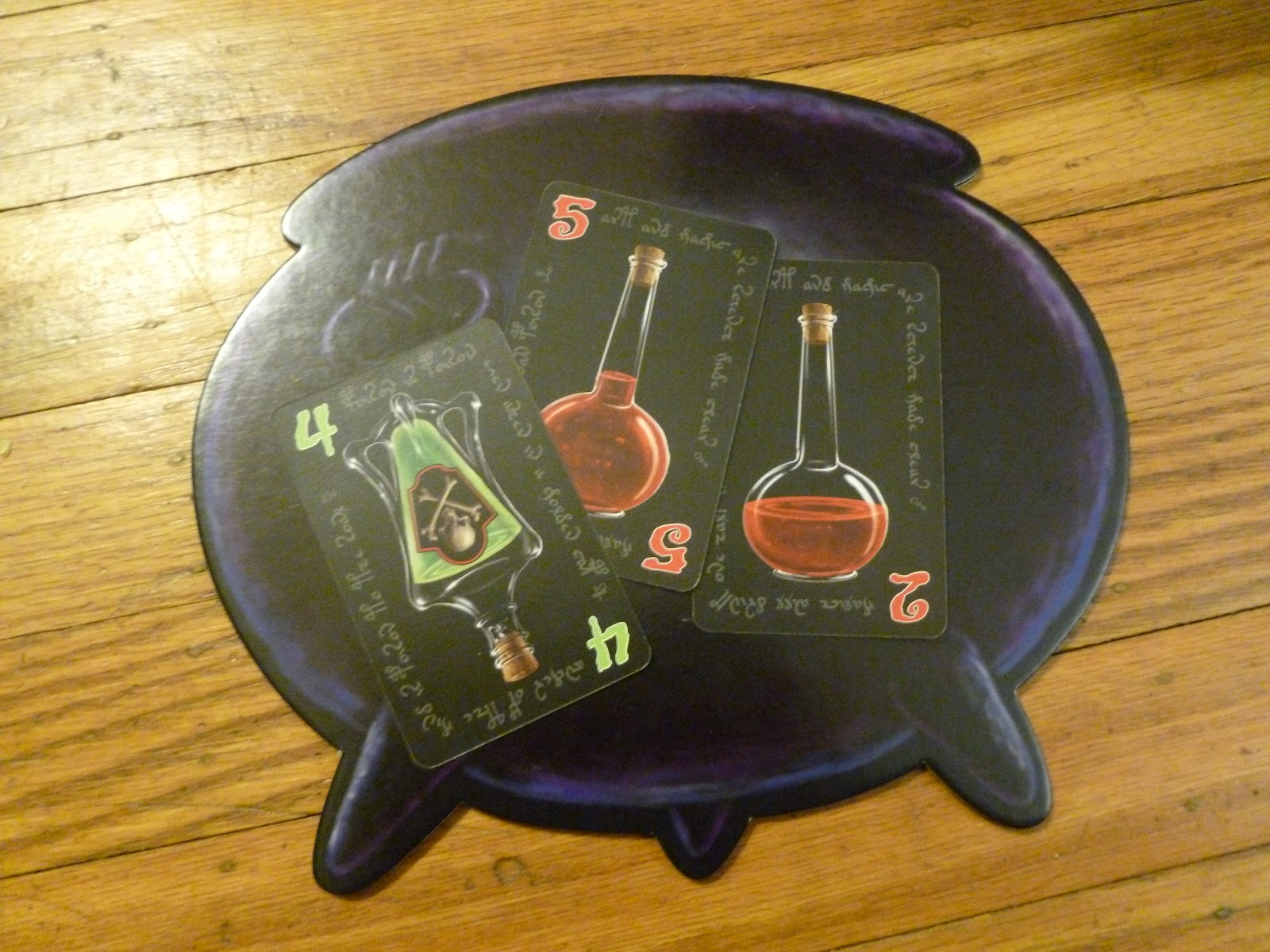
This is a rather short card game coming to us from one of our favorite game designers, Reiner Knizia.  There are three cauldrons in which to brew potions, and set of cards with potions of four different colors - red, blue, purple, and then the green "poison" cards.  Each cauldron can only hold one color (not counting the poison cards), and can only hold up to 13 points total.  The cards have values on them that range from 1 to 7.  Players go around playing potions into cauldrons, and if you force a cauldron to go over 13 points you must take all of the cards in that cauldron.  At the end of the round you tally up the potions.  If you got the most of one color (not counting the poisons) then those cards don't count for you.  Whoever has the least amount of points wins.

Interestingly, there is also a different, slightly simpler version of this game known as Baker's Dozen.

3-6 players.  15-25 minutes.  No expansions available.  Easy learning curve.

Becky says:

I like having some good, quick games that still involve strategy and fun.  This game does that.  At first the strategy seems clear cut - avoid taking any cards.  This is usually done by placing your largest numbered cards, like the 7's, first, so that later on you have some 1's and 2's to help you out in avoiding taking the cauldron.  However, sometimes the strategy of trying to get all the cards of one color will work really well.  You have to make that judgment based on what hand you are dealt.

It's easy to learn and easy to explain, which I appreciate.  It's a good filler game but it also isn't too predictable.  I also appreciate games of numbers, which this essentially is.  Other than that, however, I  don't really have a ton to say about Poison.  It doesn't wow me like some other games do, probably due to the simplicity, but I really appreciate it for what it is.  8 out of 10.

Jason says:
When I host a board gaming night, there are two classes of board games that get played: the big games that can take a lot of focus and energy, and the little, intermittent games that are played to cool down between big games.

Granted, it’s not just black and white, and a little game doesn’t have to be played as a little game, and maybe some people don’t even agree on which little games are little.  All I know is that I don’t think of playing Pandemic as a relaxing “warm-up,” and conversely I won’t call Incan Gold the pinnacle of hard-core gaming.  I would play Incan Gold to get things moving, and when everyone’s gotten comfortable, I will bring out Pandemic.

Poison falls into the “little” category, where it’s a simple game with simple rules and a simple objective.  Sure, it’s not going to floor many people with its amazingly intricate gameplay, but it does very well for the category it’s in.  It is fun, and it is definitely worth having in your collection of games.

The game plays very much like Hearts or Pinochle, yet it has a more contemporary flavor to it.  There is definitely strategy to it, and I think if I played it enough, I could get very, very good at this game.  Despite that, just like Hearts and Pinochle, it’s random enough that periodically you can get a stinky hand that just isn’t meant to win.  That’s not a bad thing either, because it keeps even the skillful potions experts feeling mortal.

Also, the artwork is fascinating, the cards look really cool.  It’s a pretty game, what little there is to be pretty.

Now, let’s bring this back around and think: what did I rate Pandemic and what did I rate Incan Gold?  I bring this up because I want to emphasize a very important point: “little” games are not inferior to “big” games.  In my opinion, Incan Gold beats Pandemic by a whole 2.6 points out of 10, and it is a well-earned extra 2.6 points.

I am really fond of Poison.  I think I will rate it an 8.1/10 and because it’s a little game and because it can be a good gateway game, I give my personal recommendation that every gamer have this game.

Tuesday, July 3, 2012

Citadels

Citadels is a card game in which you collect gold in order to build "districts."  Each district costs a certain amount of gold.  The game ends when one person has built 8 districts, and whoever's districts are worth the most (including some end of game bonuses) wins the game.  Every turn you have the option of either taking two gold pieces or drawing two cards and keeping one.  You then have the chance the build a district.  Then your turn is over and it's on to the next person.

It sounds pretty simple, right?  Well, the twist comes in with the roles/characters.  There are 8 characters, each with its own special ability.  The thief can steal gold, the merchant gets a gold bonus, the architect gets extra cards, etc.  The cards are passed secretly around so that you can select your role - and try to guess what the person before you took, and what the person after them took.  It's not as easy as it sounds to pick a role.  If you want more gold, you'll be tempted by the merchant - by the assassin might want to prevent you from getting that gold and will kill the merchant.  It's all about strategy, and who you pick can make or break the game.

2-7 players.  45-60 minutes.  Dark City expansion available.  Medium learning curve.


Becky says:
For some reason, Citadels tends to fly under my radar.  I'm never dying to play it, and I don't think I'd ever suggest it, but if someone else suggests it I'll definitely play.  I just tend to forget about it, mostly.  It is a fun game, it just isn't a stand out for me like some of the others that we've played.

Our group tends to have a rather large problem that others might not experience, and that's how much downtime there seems to be.  We play with many people that really take a lot of time to strategize and plan out exactly what move they're going to make.  The process of choosing what role you want and then pass the cards around can take over 5 minutes for us.  I've heard from other people that their games don't take nearly this long, so this might only be a concern if you know you play with a group of people that like to take their times with stuff like this.  Also, once the round begins, you take your turn one player at a time, and the majority of other players turns don't affect you, so there's some down time there as well.

But on to the good things: it does take some interesting strategy to try and win the game.  If you want to do well you'll be tempted to take the more powerful characters, like the merchant, who gets plenty of extra gold.  But the powerful characters also have a big target on their backs, so you can be sure the assassin and the thief are after them.  You not only have to make good decisions for yourself, you have to predict what you think your opponents will do and how it will affect you.  And they're doing the same thing, so they might do something different than they normally would if they're thinking about what you're doing.  It's definitely a game where it helps to know your opponents and their style of game play.

One other comment - the two player version of this game is a big flop, in my opinion.  Even though they try to change the rules up to make it less predictable, it doesn't really work.  You can still tell pretty easily what your opponent has chosen.  Plus, the person that goes first seemed to have a gigantic advantage and pretty much controlled the game.  I wouldn't bother with it if you've only got 2 players.

Overall, we play Citadels infrequently enough these days that I enjoy it when it does come out, but I'm never dying to play it.  It's good when we need a change from the regular games we've been playing.  I'm also surprised to find out that Jason enjoys it much more than I realized, as you'll see below.  As for me, I give it a 6 out of 10.

Jason says:
Citadels.  It's a game.
Yep.
It's one of my favorite games, actually.

What stands out about this game is the characters and how much sway their powers hold.  Picking the wrong character can cost you a turn, or all of your gold, or a large portion of your points, maybe a combination of the three.  So basically, the stakes are really high every turn.

Also interesting is that it isn't a matter of numbers or excellent strategy, it's actually a matter of understanding your opponents' motivations.  When you lose your gold, it's because someone else decided to steal from your character; tough luck, you might've avoided it had you considered that that person would steal from the character you picked.  Lots of people suggest that they just have rotten luck playing this game.  However, I say that luck really isn't much of a factor in this one.  Instead, it's about figuring out what everyone will do and how you can maximize your profits from the way things will go.  The strategy eludes lots of people, and lots of other people just don't want to put forth the effort to think things through.  Of course, flying by the seat of your pants is a legitimate strategy, but if you're playing with someone who is really attentive, it is also a losing strategy.

So my short description of the game's great qualities is this: the strategy is person-centric and relies only a little on luck; any single turn in this game is high-stakes, giving the game an extra sense of intensity; the game is simple to learn, but monolithic to master.

Citadels has drawbacks too, and one of them is that some people will be intimidated or discomforted from the intensity of the game.  Some people show this through nervousness, while others simply fail to see why it is so intense.  The game is not for everyone.

So, when playing with those kinds of people (the people that this game isn't for) you get several phenomena; they get distracted during character picking, or they stop caring because they don't "get it."  Unfortunately, this brings the game down for everyone, because it's such a person-centric game.  I'll admit, it feels like a slow game, but it will only feel slow if you fail to see the value of paying attention to the important decisions.

This was a tough review, because no words can truly describe what it feels like to play a good game of Citadels.  I will give Citadels a 8.8, and that is out of a possible 9.999995, but since 99.99995% (also known as 5σ) is good enough to declare a discovery in high-energy physics, it's as good as a 10 for me.  So, 8.8/10.

Monday, May 7, 2012

Battle Line


This two player card game is a competition to see who can win the most “flags” in this war.  You start out with a row of 9 flags, and players take turn laying down cards on their side of the table.  The cards range from 1-10 each in 6 different colors.  Once three cards have been laid by each player on one flag, that flag is complete and you see who won.  The best combination of cards you can get is a straight (8,9,10) all of the same color.  Then three cards of the same number but different colors, a straight of different colors, and so on.  Whoever has the better set of cards claims the flag.  You can also claim a flag on your turn if you can prove the other person can’t possibly win it no matter what cards they play because of what is already out on the table.    The game is over once one player has claimed 5 flags, or if they claim three flags that are next to each other.

What makes the game a little more interesting is the tactics cards.  These can be played on a turn instead of a regular card and have special effects, such as being a wild card or requiring a flag to have 4 cards on each side. 

2 players.  Approximately 30 minutes.  Easy-Medium learning curve.

Becky says:
It’s nice to have some good two player games for when our friends and family aren’t around and it’s just Jason and me.  Previously the only two player game that I had which I really enjoyed was Lost Cities.  Battle Line has a similar feel to Lost Cities but it’s a bit more complex, which I like.  It’s by the same designer, Reiner Knizia, who I’m a really big fan of.  I didn’t think much about designers/companies before, but now that I have experience playing  a wide variety of games I am starting to notice that I favor some designers over others.

There is a bit of luck involved here, but it’s really a lot about the strategy.  If you have several 9’s or 10’s, do you lay them down for the three of a kind?  Or do you try to build up for the more powerful straight first?  The game can also turn very quickly.  You might start out with some good cards, but if you don’t play them right you’ll probably lose.  Another common mistake I’ve noticed is that you don’t want to commit yourself to one thing on one flag, so you spread out all of your cards on different flags.  Then, if you get something that doesn’t fit with what you’ve already played, you have nothing left to do with it.

I think the most complicated part of the game is flag claiming.  It’s up to you to figure out when you can claim a flag, which means you have to be aware of everything and watching like a hawk.  This makes the game more challenging, but in a way it’s frustrating too.  Since you have to watch everything and contemplate every move carefully, it can drag the game out – especially when it’s not your turn, it’s easy to get bored.  I am also too honest of a person sometimes.  I feel badly if I see that my opponent can claim a flag but they haven’t realized it.  Sometimes I tell them.  Maybe I am too honest for this game, but I rationalize it by saying, “It’s the first time they’ve played” or “the second time they’ve played.”  How many plays do they get until I stop feeling badly?  I’m sure there’s a cut-off somewhere, but this game is still too new for us to be there yet.  But that is more of my own personal flaw then the game’s!

Overall I really enjoy this as a two player option.  Although it can feel long depending on who you’re playing with, it actually doesn’t last that long and it involves some really good, complicated strategy, which many two player games seem to lack.  I give it an 8 out 10.

Jason says:
I am finding it difficult to rate Battle Line because I don’t categorize two-player games the same way I categorize group games.  For one, I don’t like two-player games as much.  For another, I like to think of group games as sort of special events; I would call up a group of friends to come play games like Carcassonne, Bang!, and Dominion, but I wouldn’t call up a friend to visit just to play Battle Line, or Lost Cities, or Balloon Cup, et cetera.  Maybe it’s just a mental block that I need to eventually get over, some hidden prejudice against two-player games.

It’s a good game with good gameplay.  I suspect that, much like Chess, there are good opening moves and there are bad opening moves, and these are things that a player just has to experience (or maybe read about) to get a feel for what works and what doesn’t.  As the game goes on, it becomes a lot clearer how the pieces have fallen, and it really comes down to seeing whether or not your early-game preparations will see you through to the end (with a little bit of luck drawing the cards).

The game is lots of strategy, but it is also some luck (the kind of luck that is still strategy because you can still pick the “more likely” lucky outcome).  I like that.  I also feel like this game is the spiritual relation to another game, Lost Cities.  It plays the same sort of way that Lost Cities does, with each player playing unique cards on their sides and sometimes being forced to play cards they don’t like.  Except Battle Line takes a longer time getting there and just seems generally harder to comprehend.

So I’ll suggest this: I am not fond of games that have a high level of “obfuscation.”  By that, I mean that if I’d rather read War and Peace or read Ulysses than read the rulebook, that’s bad.  If the rules are about as intuitive to my experiences as quantum physics is to the Classical Model, that’s bad.  If I liken the game to Rube Goldberg machines, that’s bad.

Why is this game a Quantum Rube Goldberg Machine with an instruction manual written by James Joyce?  Okay, that’s a gross exaggeration.  But even though it’s a good game, there are games out there that do more for me, and do it better.  Lost Cities plays the same sort of way but is far less confusing, goes faster, and is still skillful.  If I wanted a hyper-strategic game that makes even my brilliant brain itch, I’d go with Chess.  Lastly, if I wanted to make pretty matches of cards, I’d play Rummy.

For now, I’ll give two-player games a different rating system, until I can come to terms with two-player games and (n>2)-player games in the same space.  Battle Line gets a B grade from me.  I guess now is the appropriate time to say this: I’ve never once earned a victory in this game.  I did technically win once, but it’s because the other player was distracted.  And I failed to clarify a fairly pivotal rule before it became pertinent.  And it was a pity-rematch anyway.

Tuesday, April 3, 2012

Bang! Gold Rush

For the original Bang! rules and review, go here.  Gold Rush is the most recent in a line of many expansions for Bang!.  There are two major differences in the game: the gold nuggets and equipment deck, and the shadow variant.  First, the equipment deck.  This is a new deck of cards that you can purchase while you play.  Some of the cards you use immediately when you buy them, others are cards that are put in front of you.  They can cost anywhere between 1 and 5 gold nuggets.  Three cards are face up and available for purchase at a time.  The way you earn gold nuggets is by attacking other players.  Every time you cause someone else to lose a life point, whether it’s from a bang! card, Indians, duel, or whatever, you gain a gold nugget.  You can also trade in beer cards to gain gold nuggets.If you want to destroy a permanent equipment card in front of another player, you can’t use any regular cards like cat balou – you must pay gold nuggets equal to the item plus one.  There are several new characters added to the game that have powers that have to go with gold nuggets and equipment cards.

The other major change is the shadow variant.  This effectively allows players to continue playing, even when they’ve been eliminated.  If you’ve been killed, at the start of your turn you draw two cards that you can attempt to use.  You don’t get any life points back and you also don’t get to live.  You use what cards you can and discard the rest.  You can, however, hold on to your gold nuggets that you’ve earned, which allows you to buy immediate use equipment cards.  Once your turn is over you go back to being dead.  If the renegade is killed, he joins the team of whoever has the most people dead (outlaws or team sheriff).  You can choose to play Gold Rush with both new elements of the game, just the equipment cards, or just the shadow variant.

4-7 players.  An expansion to Bang!  Easy learning curve if you’re familiar with the original game.

Becky says:
First, the equipment cards and gold nuggets.  They are a lot of fun and add an interesting element to the game.  Everyone we’ve played with seems to really like this addition.  Most of the cards are fairly straight forward – use as an extra bang or an extra cat balou, or put it in front of you and you can now hold up to 8 cards in your hand.  These are neat.  There are also ones that seem a little too good and pretty much give you the power of another character.  For instance, there is a card that makes it so that cards with a diamond do not affect you – that’s Apache Kid’s power, and a 3 life point one at that.  However, the “really good” ones are not too many of them, and there are many of the other cards, so you may not even see these at all every time you play.  One thing I noticed about the gold nuggets – people get greedy for them, and they speed up the game considerably.  You see something that you like out on the equipment deck, so you shoot whoever’s next to you to get nuggets, not really caring who they are.  This can mess with the strategy a little bit and makes the game a bit more… blood-thirsty.

Now, the shadow variant.  What I love about this is that it means you’re never completely out of the game.  You still get to keep playing, which was a bit of a flaw before.  We would have people die in the beginning or middle of the game and still have it go on for 45 minutes, while they had to sit there and do nothing (or more likely, text someone or play Words with Friends).  I know some people feel it makes the game longer but I don’t think it does very much, because the shadow turns are so brief.  And when you combine it with the gold nugget stuff it evens out.  We have noticed a trend when we play with the Shadow variant though, and that is that it seems to help the sheriff’s side way more than the outlaws.  I haven’t quite put my finger on why that is, but most times the sheriff wins when we play shadow variant – it seems like a bit of an issue for a balanced game.

Finally, the new characters.  For the most part I think they are very good.  Most of them deal with the new gold nuggets and equipment cards, such as Raddie Snake, whose power is that he can choose to exchange a gold nugget (up to 2 times per turn) to draw an extra card.  However, there is at least one character that seems pretty unbalanced and too powerful.  That’s Don Bell – his power is that at the end of his turn, he “draws!” and if it’s a heart or a diamond, he takes another turn.  Effectively it means that every turn he has a 50% chance of getting another turn right away.  And he starts the game with 4 life points.  If he had 3 I could maybe be okay with his awesome power, but 4 is too much.  Too powerful characters either dominate the game or get killed right away.  Our Don Bell got killed right away because his power was too good and no one wanted to see it used.  They all ganged up on him just to get him out of the game, which is really no fun either.  Also, other older characters might not be as good in Gold Rush – we discovered that “Big Spencer” became a “Big Target” when people wanted gold nuggets because he almost always has to take the hit.  Poor Big Spencer got killed right away, and people gained a lot of gold nuggets.

Overall I really like the gold nuggets and the equipment deck.  They speed up the game, which has always been an issue with us.  I also do like the shadow variant because I hate being killed and not getting to play anymore, but I can understand why some people don’t like it.  I give this expansion an 8.5 out of 10.

Jason says:
Dodge City pushes the game further along the asymptote toward perfection, High Noon/Fistful breathes further life into it, and Wild West Show sorta-kinda goes overboard a bit.  Gold Rush puts in a good effort, but for me, not good enough.

I commend Gold Rush for trying to fix the dead-players-out issue.  Unfortunately, the fix is a problem in itself.  In theory, gold nuggets are a good addition that fit into the genre; I like the fact that it is an extra incentive for shooting people.  I do not like the fact that it adds a whole separate class of cards that don’t really mesh with the rest of the game and that are supremely powerful.  When a card like the Calumet or the Boots comes up, there is no reason not to go for them.  Worse yet, those cards are duplicates of powers already assigned to characters, making those characters less unique.  There is something sacred to me about powers.  They are things that make a player feel like they have a personal edge… but not anymore.  I will no longer pick Apache Kid if I know I can just grab a Calumet.

Next are the extra rules to fit the expansion in with the rest of the deck.  First, you can discard beers without regaining life to instead take a gold nugget; bad, it doesn’t make sense.  Second, black-border cards cannot be discarded by Cat Balou; bad, too powerful.  Third, you can force other players to discard black cards by paying the price of that card + 1.  Why would a living player ever do that!?  Just buy your own black-bordered cards if you have enough money!  Only a ghost would force discards, since they could never hang on to black-border cards themselves.  What a boring way for a ghost to spend its hard-earned nuggets.
That brings me to the Shadow Variant, inherently flawed because it requires the gold nugget part to play well.  I think it is a bit too powerful, since it’s almost the Ghost Town card from High Noon, permanently (making that card a moot point also).  As an added minus, it ruins more cards, like characters Pedro Ramirez and Kit Carlson who can manipulate the draws of the next player, but not if a ghost throws off all of that planning.  Silliest yet, the Renegade is no longer a Renegade when he dies, and is instead a swing-vote for the losing team.  It’s all very unsatisfying to me.

My last thought is the characters, which are, to varying degrees, over-powered.  In particular, Don Bell, who gets to play an extra turn on aDraw! of hearts or diamonds.  Arguably better than Black Jack in every way.  This is just another example of a card that I think directly suffers because of this expansion.

So you might be thinking, “Wow, you just panned that game like a prospector in a gold rush!  Can you do better?” to which I would say, “Good pun!  And yes, yes I can.” The market part is a completely separate deck of cards that don’t really fit into the rest of the game.  Instead, why not make a market out of cards from the deck, all costing four nuggets?  As for the Shadow variant, instead of interrupting the flow of the living players’ cards, maybe allow dead players to take one of just a few indirect actions, or maybe have a separate deck for them to play off of (I know there is a website called the Bang! blog which has an unofficial expansion that does this).

So what does it come down to?  I will give Gold Rush a 5.75/10, which mathematically comes out to a 5.75/10.  For all of the panning I did, I would have given it a much lower rating, but I do respect that Gold Rush speeds up the game and allows dead players to play.  I wouldn’t personally include Gold Rush in a game of Bang!, but our house rules say that the designated Sheriff gets to determine the expansions we play with, and if that sheriff says Gold Rush, I won’t say no.

Tuesday, March 27, 2012

Dominion

This is a deck-building card game in which players attempt to earn enough points to be the others.  Everyone starts with a basic hand of 7 copper coins and 3 estate cards (worth one point each).  Each turn you play off of your own individual deck.  The turn begins by drawing five cards.  You then have an action phase, in which you can play action cards.  Then there is the buy phase, which allows you to purchase new cards to add to your deck – these might be action cards, money cards, or victory point cards.  Finally, you end your turn by discarding all cards played and any that still remain in your hand into your own personal discard pile.  You immediately draw 5 new cards from your deck to prepare for your next turn.  When you run out of cards your deck gets reshuffled.  The game continues in this manner until either all of the province cards are gone (victory point cards worth 8 points) or when any other three stacks of cards have been exhausted.

2-4 players.  Multiple expansions and other stand-old versions available.  Approximately 30 minutes.  Easy-medium learning curve.

Becky says:
One nice thing about this game is that the basic rules are simple enough.  The variety of different action cards can make it seem a little overwhelming, but once you accept that you’re just going to have to take some time to read the cards and get to know them, the game can go pretty quickly.  One thing that I really like is how the playing experience can be different every time, depending on what cards you use.  There are pre-set arrangements that they recommend, but you can also just randomly select which cards will be played with for each game.

One thing that is both a pro and a con is that it can be very difficult to figure out what strategy you want to use, and that can change depending on which cards are used.  Many people I play with build up these amazing chains of action cards, going through almost their whole deck in one turn.  Somehow I just can’t get that strategy to work for me.  I find that if I’m buying action cards it means I can’t upgrade my coins, and if I have mostly action cards I don’t have enough coins to buy what I want anyway.  It’s a delicate balance that you have to find. 

I also love how fast paced the game is.  It’s not like Citadels, where I feel like we wait forever for everyone to make their selections, or even Bang!, where a turn can drag out for far too long.  I know Jason will complain that this game doesn’t move quickly enough for him, which frankly I don’t understand.  I find that half the time, by the time that I have drawn my cards for my next hand and figured out what I want to do with them, it’s already my turn again.  I will note that we don’t own this game, his brothers do, so we only play when they come over which means that it’s always a 4 person game.  It would be interesting for Jason to try 2 person Dominion and see if that fixes his issue with the pace.

While Dominion is a very good game, if I have to note some negatives I will say that it doesn’t always seem perfectly balanced, especially when you choose which cards to play with randomly.  Sometimes it feels like you are getting nowhere fast, so you might as well start buying Duchys so you can get some points.  And while I don’t have a problem with the general idea of the attack cards, some of them seem much worse than others and a few I personally feel are too harsh or annoying and don’t really add much to the game.

Overall I enjoy Dominion, but probably not as much as I could because Jason usually is resistant to play, and what fun is it to play a game when one of the players isn’t into it?  I still give it an 8 out of 10 as it’s a fun game and I am pretty much always willing to play it.

Jason says:
I was really fascinated with Dominion the first time I played it.  It was like a breath of fresh air.  It’s another one of those solitaire-feeling games, where you play your game, other people play their game, and (except for a few exceptional cases of indirect influence) everyone compares their work at the end of the game.  In my mind, I put it into the same style class as 7 Wonders.

Like Bang!, Dominion fills a void in my gaming heart that was once reserved for collectible card games.  Bang! fills the game playing part, but Dominion appeals to the deck-building fun.  Yes, a lot of the fun that people find in collectible games like Magic: The Gathering is the search for the perfect deck design.  Dominion knows this, and it turned that search into a game in and of itself.

Regretfully, the more I play Dominion, the less fond of it I have become.  It is fast-paced, especially for a game that goes by turns, but I still get impatient waiting for people to take their turns.  Normally I have the patience of an immortal, but Dominion just hits some spot in my brain that can’t seem to wait.  That complaint might just be my personal problem, so I think others should judge for themselves on that; let me know what you come up with.

My real gripe with the game is the Attack cards, the part that makes people interact more directly.  Because the game feels like such a personal endeavor, attacks and disruptions feels contrary to the spirit of the game.  Also, they make the game slow down more.

I rate it a 6.6/11, which really just comes out to 6/10.  Even though it is one of the lower scores I have given and despite how critical I am of it, I do enjoy playing it, and there are many times I would rather play Dominion than games like Pandemic or Bohnanza.  I will point out that almost everyone I play games with disagrees with how low a score I gave to Dominion, but because of how impatient the game makes me, I'm sticking with my decision.

Monday, March 19, 2012

7 Wonders

This is a card game in which each player is working independently to create their own civilization.  You start off with a hand of 7 cards, of which you can pick one to build.  The rest get passed to the person next to you.  You usually start by building resources, which are often free, and then you have to use resources to pay for bigger things you want to build later.  There are also ways to earn coins, which can help you pay to build cards.  There’s a variety of different card types of build, and it is often good strategy to pick one or two card types of focus on that.  They include military, civilian structures, commercial structures, scientific structures, and guilds.  The game has 3 rounds, and at the end you add up the points that your structures are worth and whoever has the most points wins.

One other aspect of the game is your wonder.  There are seven different ones, and each one has different rewards on the bottom.  At any point during the game instead of playing a card you can choose to build a level on your wonder and get the reward for that.

2-7 players.  1 expansion available (Leaders) and one coming out soon (Cities).  30-45 minutes.  Medium learning curve.

Becky says:
For one reason or another, I was a little bit hesitant about trying this game, and didn’t really care for it the first time I played.  All of the different cards just seemed so overwhelming, and I was playing with people that had played several times before.  I didn’t even understand what those “green cards” were, and so I ignored them – while other players were getting 30 points from them!  When it comes down to it, though, I really enjoy the game after playing it more.  It is very similar to other card playing, point gathering games, such as Race for the Galaxy and Dominion.  While I am not great at those games I really like them.  I think one of my favorite things about such types of games is that it doesn’t feel as competitive as other games.  You are working on your own little thing and not caring what other people do very much, except maybe when passing cards or building military structures.  That’s not to say that you shouldn’t pay attention to what other people are doing – that’s a good way to lose the game.  But it’s not usually your main focus.

Another plus – I really love the little scoring pad.  It seems like such a simple thing, but it helps a lot for tallying up the points at the end.  Speaking of scoring, while some of the areas are straightforward in terms of scores, other ways to gain points are a bit more subtle.  Science, for instance, is probably the trickiest type of card to go after.  Military is somewhat straightforward but the results can vary greatly depending on what the person next to you is doing.  I like the fact that there are different ways to play the game.  I often alter my strategy based on which wonder I get, which makes the game fun and a little different every time.

The biggest downfall for me is that sometimes you just can’t get the right cards.  I was stuck in a game once where I built the resources I thought I would need, and then it turned out there were a few other things I needed later on – which neither of the people next to me had.  So I just went turns where I couldn’t build anything at all, or had to build pathetic little things.  Those games are very frustrating, though that may just be bad luck.  You also have to keep in mind that the game changes based on the number of people playing.  If you have less than 7 you remove cards from the deck.  If you’ve played a lot and have specific cards in mind that you might be searching for, it can be difficult to remember which ones remain in play with fewer people.

Overall I give the game an 8.5 out of 10.  I enjoy playing it a good deal but it doesn’t quite make it to my list of favorites.

Jason says:
Before having played this game, I had been exhausted of all of the "point-scoring" games out there because it had become a stale mechanic to me.  Ticket to Ride, Carcassonne, Master's Gallery, tons and tons of other games out there are just mathematical processes (these are all games that we will review some day).  They just bored me (I'll also talk/rant about that some day).  But when 7 Wonders came around, it was unique, it was entertaining, it was complex, and most importantly, it was just plain fun.

One of the best parts of 7 Wonders is that everyone takes their turns at the same time.  Fast thinkers and impatient people can breathe a sigh of relief when they play this game, because every turn is your turn.  On a turn, each person selects a card from their hand, then everyone plays their selected card simultaneously.  When you have seven people playing the game, that's seven turns for the price of one!  For comparison, imagine how long it would take if seven people all played Carcassonne.

Alright, so far, I've given this a pretty good review.  What's the catch?  Glad you asked.  The learning curve is steep and high.  Someone playing for the first time shouldn't expect to know what they're doing at all.  You can have an expert teacher who can literally insert information directly into your brain, but you won't completely understand what a good strategy is until you play the game through once.  Maybe even several times, depending on 1) how experienced you are with games in general, 2) how genuinely interested you are in trying to learn the game, and 3) what hints your teachers give you through those playthroughs.  The game is great though, provided you stick it out for that first game.  or five.

So I think I'll give this game a 2.7/3, but of course, if you run through the math, 2.7/3 is exactly the same as saying 27/30, and if you divide both the numerator and the denominator by three, you end up with a 9/10.  So there it is.  9/10.  Or a grade of 90%.  Revel in this, because not many more games will get the "A" rating that I've been giving out lately.

PS: Yes, I know that Carcassonne only holds up to five people.
PPS: If you've never played Carcassonne, then just substitute your own experience with a game that's wretchedly long because everyone takes their turns separately.

Sunday, March 4, 2012

Bohnanza

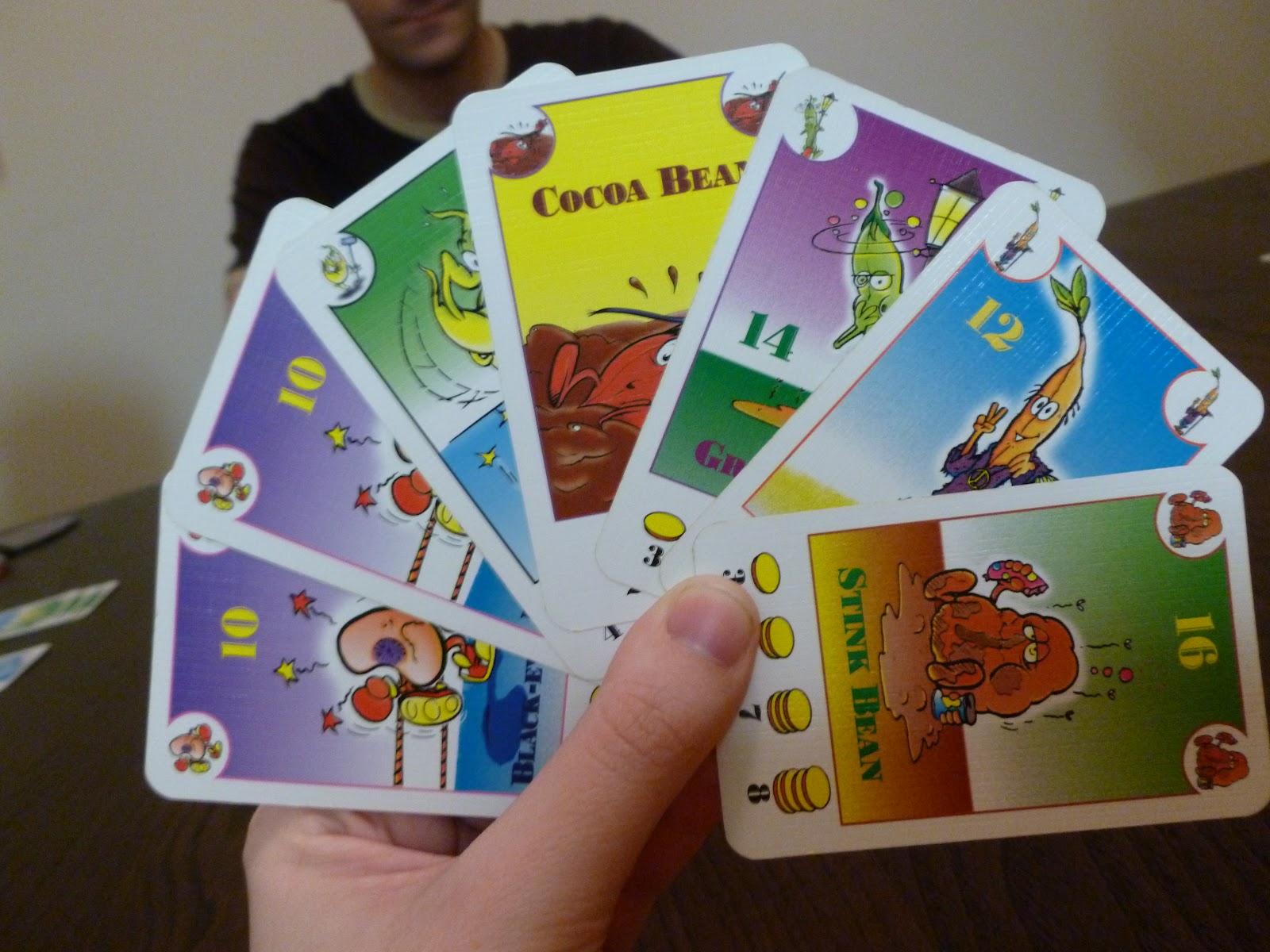
In Bohnanza, you are a bean farmer.  Your goal is to grow beans in order to gain coins, and have the most coins by the end of the game.  There are a different types of beans in the deck, and each bean has a different number of cards in the deck.  For example, there are 22 wax beans in the deck, but only 4 cocoa beans.  In order to make money off of your beans you need to plant a certain amount of them.  For more common beans, such as wax, you need to plant more than you would for the rare beans such as cocoa or garden beans in order to get a good pay-off.  When you are ready to plant different beans, you dig up the ones you have and earn the coins from that.

You start with a hand of cards, in which order matters.  That means that however you pick the cards up is the order in which you must play them – you can’t move them around within your hand.  You have two fields in which to plant beans.  At the start of your turn you must plant the first bean in your hand, and you may plant the second one if you want.  You then flip over two beans face up from the draw pile.  You can choose to plant these beans , or you can trade them for beans you actually need.

What this game is really about is the trading.  You can trade what you turn face up, but on your turn you can also trade from out of your hand.  There aren’t many rules about trading – almost anything goes.  The only major rule is that when you trade, you must plant the bean that you get, you can’t just put it into your hand.  Trading from your hand is a good way to get rid of beans that you don’t want that are in your way.  You go through the deck three times, and at the end of the game you count up the number of coins you have from planting beans – the player with the most coins wins!

2-7 players.  Multiple expansions available (Bohnaparte).  Approximately 45-60 minutes.  Easy-medium learning curve.

Becky says:
Bohnanza is a fun little game, and pretty easy to get the hang of quickly.  The cards and brightly colored with cute pictures.  In terms of game play, I do like it.  I wouldn’t say it’s my favorite game, but it’s fun.  It’s a very social game, as you are constantly trading or bargaining with people. 

I think the trading is fun, but it certainly depends on who you play with.  You also tend to develop certain “types” of traders, which I’ve developed names for.  There’s the “Too Nice” trader, who will give you the beans you want even if you can’t offer anything in return.  This person tends to go with the line, “just remember it for next time!”  Then there’s the “Miser,” who doesn’t want to trade anything that will help anyone else – unfortunately, that often puts them in a bad position but they’re usually too stubborn to act any other way.  And there’s also the “Bargainer,” who is constantly trying to get a better deal.  “A wax bean for a blue bean?  I could do that, but how about you throw in a stink bean too?”  This person can get very greedy and frustrating to trade with.  It is interesting to see how your friends and family act when it comes to trading beans!

On the negative side, this game can get really long and slow moving if you play with too many people.  This is especially true if the people you play with are stubborn – “But I don’t want to plant this blue bean!  Won’t anyone trade with me?  No?  Well, I’ll keep offering different trades for the next ten minutes anyway.”  The game holds up to 7 but that can often be way too long.  It’s a fun game, but most people don’t really want to be planting beans for 2 hours.  I find it works really well with 4 or 5 people, especially if they already know how to play.

In the end, it’s not a game I want to play all the time, but I enjoy it every once in awhile.  I don’t feel it’s particularly outstanding in any way, but it’s just fun with a little bit of strategy.  And sometimes, you don’t need a crazy, complex game – you just want that game that lets you have a good time without too much effort but still requires a little brain power.  Bohnanza fits that niche well.  7 out of 10.

Jason says:
Bohnanza.  Here I am, an American writing a review of a game by the German publisher Rio Grande games.  I always liked that about this game.  It has nothing to do with the review, but I thought I would share that.

Interesting game, certainly another unique one, which I say because I haven’t seen another game that does quite what Bohnanza does.  The game is simple; you plant beans, you dig up beans, you get money.  Your friends are also doing that.  The trick is that everyone wants stuff that everyone else has.  So it’s really a game about trading in a way that makes your hand work as well as it can, which can be especially difficult since the order of the cards in your hand matters.  Yes, a stink bean in the back of your hand could be just the trade leverage you need to secure your new bean farm, but a stink bean in the front of the hand could spell disaster for your hard-earned bean empire, a situation that most often just… well… stinks beans.

Alright, so what about the game?  Extremely social and interactive, that’s a plus.  And it’s easy, that’s a plus too.  I would also venture to say that winning the game isn’t nearly as fun as just playing it, which I think is a big point in its favor.  Of course, with any social game, it matters who you play with, and it’s important not to get hung up on people making strange trades that you think don’t make sense: there’s no rule that they aren’t allowed, and you have no idea what kinds of beans are cluttering up their hands or how desperately they want to trade that clutter away.

Now, having said all of that, this game is a good one, but it’s not one of my favorites.  I don’t get excited when someone says, “Let’s play Bohnanza!” but that is just my opinion.  I think of it as one of those change-of-pace games for when we’ve played tons of Pandemic and Bang! and such.  Like any game, it has its deficiencies.  It can drag a bit if people aren’t focused or if the trading gets too involved.  There may also be a person or two who simply can’t get their bean machines working because that’s the way the cards are dealt.  But I think these small deficiencies fade compared to the positive simplicity and elegance of the game.

Now, I think I will rate Bohnanza at 425.02/538, or a 7.9/10 which means that I rated it higher than Pandemic or Lord of the Rings.  But you see, when I play games, Bohnanza doesn’t really come to mind, even despite how much I like it.  I think of Bohnanza as that guy that everyone thinks deserves better, but no one really wants to throw him a bone because they think they have better things to do.  Maybe it’s just old hat for me at this point.

Saturday, February 18, 2012

Bang!

In Bang!, you get to take the role of a character in the wild west.  In fact, you get both a “role” and a “character.”  The roles include sheriff, deputy, outlaw, and renegade, while the wide variety of characters include fun names like Willy the Kid, Calamity Janet, and Jesse Jones, each with a unique character ability.  Your goal in the game varies depending on what your role is – the outlaws want to kill the sheriff, the deputies protect the sheriff and kill everyone else, and the renegade wants to eliminate all opponents except the sheriff, and then defeat the sheriff in a one-on-one showdown.  All roles are hidden except for the sheriff, so an element of the game is trying to figure out who is who based on their actions.  You get a handful of cards that can be used as either attack or protection.

4-7 players.  Multiple expansions available (High Noon, Dodge City, A Fistful of Cards, Wild West Show, and Gold Rush).  Approximately 30-90 minutes.  Medium-Hard learning curve.

Becky says:
I’ve found that almost everyone who has played Bang! has really enjoyed it.  You get to experience the game differently each time, depending on what your role is.  I also like the theme of the game and the puns on the character names.  And the title of the game can lead to plenty of inappropriate word play in and of itself.  Silliness aside, you do have to develop a good strategy for this game, which will differ depending on your role, character, and the people you are playing with.  It’s all about getting the right cards, using them well, and revealing yourself at exactly the right moment.  Interestingly, who you sit next to actually matters in this game, so choose your seat wisely!  The suspense is often quite high.  Some people feel that the game comes down to a lot of luck, and while that is sometimes true I think it is more about how you use the cards you draw.  And if you’ve revealed yourself in the first round and don’t have any missed cards, don’t be surprised when you’re dead in the next turn or two.

I shot the sheriff... many times. 
The biggest drawback of this game is that when you are killed, you are eliminated from play immediately.  If you have the bad fortune to get eliminated early on, you’re stuck watching everyone else play for the next hour.  The other big thing is that you need to stay focused.  Yes, you go around in a circle so you aren’t constantly playing.  But someone could shoot you, or play an emporio, or anything that might affect you.  I’ve noticed some people have a tendency to text, or get up and leave when their turn is done, and this significantly slows down the game time because then you have to wait for them to come back when the Indians attack.  In addition, if you’re paying close attention you’ll have a better idea of who’s who and who has what cards.

Overall this is one of my favorite games that we play because it’s exciting, my strategy changes slightly every time, and I love the theming of it.  9 out of 10.

Jason says:
Bang! starts from the very beginning as an unconventional game right at the theme, as a spaghetti western.  For anyone who can appreciate Sergio Leone’s movie trilogy culminating in The Good, the Bad, and the Ugly, this game will please your inner geek with endless quirky little jabs at the genre.  While said movie is not a prerequisite to enjoying this game, it goes a long way in helping you understand why this game is as witty as it is.  Also, it’s one of the greatest movies of all time; go see it.

Alas, theme doesn’t make the game, gameplay does, and Bang! has no shortage of exciting gaminess.  Bang! breaks the “point-scoring” mold; the objective is to stay alive long enough to make sure your enemies are underground and your friends are actually your friends.  As well, no one knows exactly who everyone else is, and that adds an exciting dimension of discovery to the game where your actions speak who you are, so you are never certain who’s a deputy and who’s that renegade.

The core gameplay is much like a game of Magic: The Gathering or YuGiOh! except that Bang! isn’t a collectible card game and everyone pulls from the same central deck of cards.  It’s a fix for a guy that doesn’t want to spend hundreds of dollars building a deck that will never be as good as the one the preppy rich kid down the street can afford.  The way the game works, you are faced with endless decisions, and any decision might be a good one.  When you win, you feel you’ve earned it because it took something like strategy to get there.  When you lose, you often know you tried your best and there was nothing you could do.  An average of good feelings all around.

Okay, so this game is not without a flaw or two, and in this case, it’s a tough one to overlook.  In Bang!, when you’re dead, you’re dead.  This is a truly unfortunate circumstance for the first player eliminated in a seven-player game who got blown away because everyone wanted to collect a bounty on what might have been an outlaw.  This first player can’t participate anymore and he can’t play another game because all the other players are still playing a game of Bang! that might go for a long time.  In larger groups, there is often one person who has to eat it simply because that’s the way the cards were dealt.  You hope this is your mild-mannered uncle who won’t mind being eliminated.

If you play this game for the first time, I have one of two recommendations: first, if you can, find someone who already knows the game well and have them teach it to you.  The game is simple but there are lots of tiny nuances that are important (like how “draw!” is different from “draw”).  Second, if you don’t have an experienced someone, you should play your first game in a group of four, not seven (or eight or nine) and use the first game to explore what the rules are talking about.  Once you’ve ironed out the details, then you can present the game to your friends and be the someone who already knows the game well enough.

Becky and I tossed around the idea of posting a video series for explaining the rules of games, so you can watch a video, get the basics, and get playing fast.  This would be the first game to get that treatment.
Ultimately, I give this game a 15.64/17, which comes to a 9.2/10.  There are several expansions to the game, and if the expansions are included, the score would go up.  Stay tuned for our reviews on them.

Monday, February 13, 2012

New Bang! Expansion

Our review on the base game Bang! will be coming soon, but in the meantime we wanted to let you know about a new expansion for this game.  It's called Gold Rush, and it adds two new major elements.  The first is a series of gold nuggets, which you can collect throughout the game in various ways.  These can be used to buy equipment, which are powerful cards that have different actions.

The other major change is the idea of the shadow gunslinger.  What this does is attempts to rectify the issue of people being eliminated from the game and no longer able to play.  Even when eliminated players will still get a turn, so they'll never really be out of the game completely.  Also included with this expansion is 8 new character cards.

It sounds like this expansion will change the game a lot.  We've already acquired our copy but have yet to try it out, so we'll see how it goes!