Showing posts with label easy to learn. Show all posts

Monday, January 21, 2013

Tsuro


Tsuro is a simple, easy to learn game using a board and tiles.  The tiles create a path for your marker to travel on.  The goal is to stay on the board, and not create a path that will take you off of it.  Whoever is the last one still on the board wins.

Players start with three different tiles from the stack.  These tiles have lines that will create various pathways.  The board is set up as a grid, and your tile must be played in front of your marker in a way that will progress it onward.  If your path intersects with a tile that has already been played, you must follow any paths that your marker comes across.  If the stack of tiles runs out you must wait until another player is eliminated to get another one.

2-8 players.  10-25 minutes.  No expansion available.  Very easy learning curve.


Becky says:
This game is super simple, and one of the best parts about it is that it is so versatile.  It makes a good "filler" game, that is, something that you can play if you're looking to pass just a little bit of time or if you don't want to dedicate a whole evening to board games (we often play in large groups where multiple games are going on at once, so we use filler games when one group is finished and waiting for the other group so we can decide on the next big game).  It holds anywhere from 2-8 players, and usually only takes around 10-15 minutes, though we've had games as short as 5 minutes and as long as 25.  It's pretty easy to explain as well.

Also, for a simple game, the artwork is really lovely.  They use some lovely colors, so instead of your typical red/blue/green/yellow pieces, you have gray, white, black, a dark red, a "caramel color," and a few others.  The dragon and phoenix art is gorgeous, I feel like it's something that I want to frame and hang up on my wall.

I personally feel that there's not a ton of strategy involved, and it tends to lean much more toward a "random" game where luck plays a big part.  That being said, there is still at least a bit of strategy, usually closer to the end of the game, to help you feel like you have a little bit of control in it.  In do encourage people to try not to strategize too much, because I think it can really slow down what is otherwise a quick game if players spend a long time analyzing each piece and trying to plan multiple turns in advance.

Overall I like Tsuro.  It's an enjoyable filler game, though it doesn't exactly blow me away in any way.   We've probably introduced it to at least 20 people by this point, and everyone that has tried it has enjoyed it - gamers, non-gamers, young, and old.  So I think there's something to be said for a game that appeals to such a wide group.  8 out of 10.

Jason says:
I've been on a bit of a kick for the smaller games lately.  The ones that don't have to be epic, intense, hours-long experiences.  Tsuro fits into the smaller category.  In fact, Tsuro may have the simplest learning curve of any game I've ever played.  Yes, it might be easier than Candy Land (because there's no counting of colored dots).

So, to recap the rules:  you have three tiles with winding paths on them.  Play one, and find out where your dragon stone goes.  Fly off the side of the board and you lose.  Be the last one in play.  I love it because a toddler could play it and enjoy it.  Even if someone can't fully comprehend the consequences of their turns entirely, it can still be a nice game with a refreshing pace and some very pretty artwork.
The whole game is over within ten or fifteen minutes, which means it definitely doesn't test anyone's patience.  Better yet, players still feel involved during other players' turns;  because of how dramatically any one tile can change the whole game, you are compelled to pay attention.

Now, there might be one criticism about the game: since every turn can have a huge impact, when more people play, it becomes chaotic to a point where it all seems based on how lucky your path is.  However, I don't think that is so, because sometimes it's just about watching the chaos unfold and having a good laugh about the crazy things the pieces do on their way off the edge of the board.  Sometimes it's just about following your path.

What can I say negatively about the game?  Well, I haven't decided if this game has a lot of replay value or not.  With fewer people, you do get more turns, but it is easy to fall into a defensive style and just try and avoid your opponent.  If this happens, you each just spend most of the game wandering around until the very end, when either you die or you don't.  If you are competitive and you try to actively thwart your opponent, it can be a little better, but then again it could still be frustrating how little control you can wrest from your opponent.  Moral of the story is this: the game is for fun, not to compete.  If you play this game just to win, then you've already lost everything valuable this game can give.

Oh, one more thing: I love how easy it is to take a conversation about the game and turn it into something philosophical, like "you must follow your path, wherever it goes," or "our paths meet, and I am in your hands now" or "the path will always end once all the tiles are played, and you should only hope to stay on the board as long as you can."  Yes, these are pieces of conversations I've actually had about the game, and for that alone, I think this game deserves some credit. 7.5/10 worth of credit.

Thursday, August 9, 2012

Poison


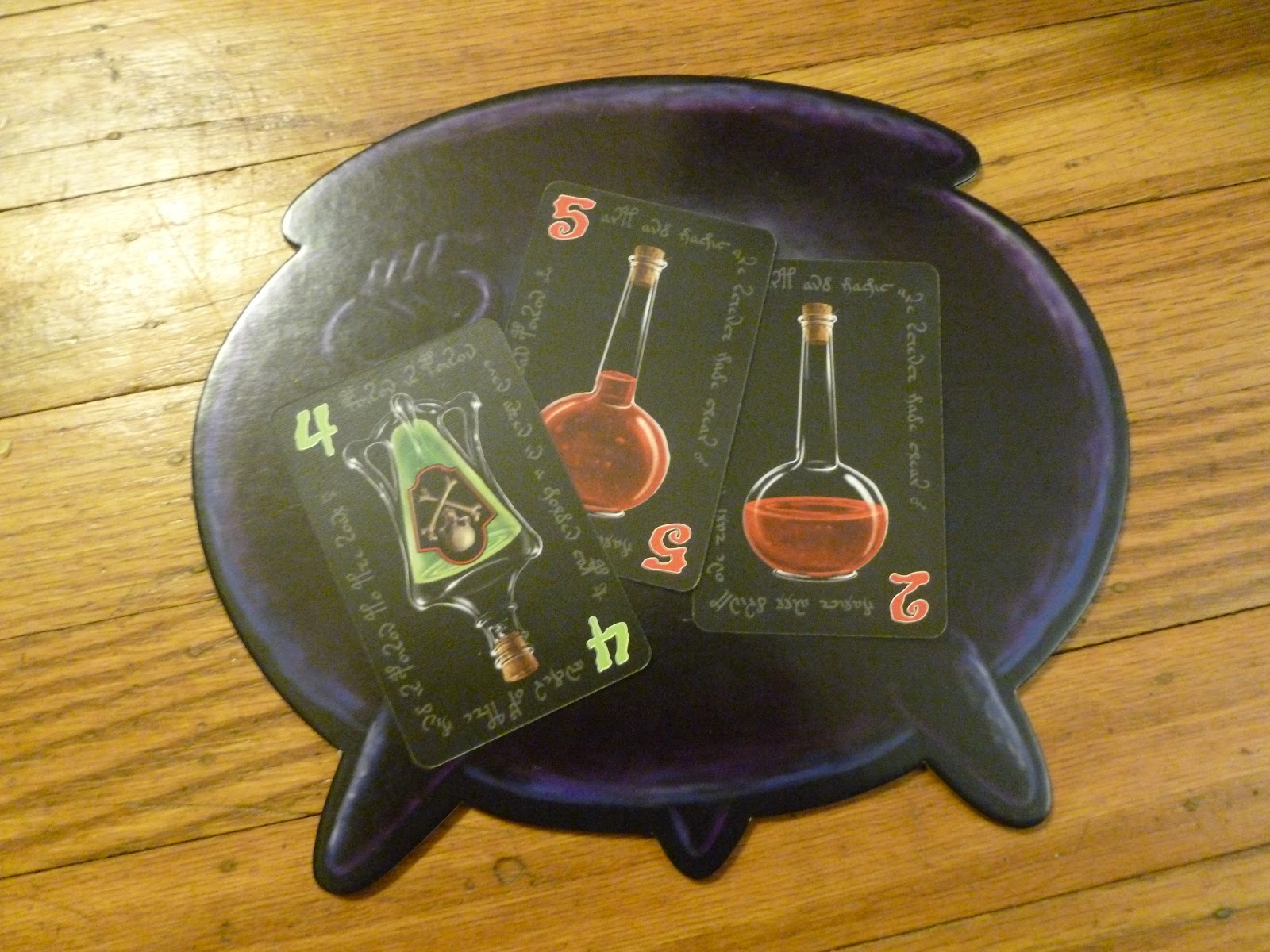
This is a rather short card game coming to us from one of our favorite game designers, Reiner Knizia.  There are three cauldrons in which to brew potions, and set of cards with potions of four different colors - red, blue, purple, and then the green "poison" cards.  Each cauldron can only hold one color (not counting the poison cards), and can only hold up to 13 points total.  The cards have values on them that range from 1 to 7.  Players go around playing potions into cauldrons, and if you force a cauldron to go over 13 points you must take all of the cards in that cauldron.  At the end of the round you tally up the potions.  If you got the most of one color (not counting the poisons) then those cards don't count for you.  Whoever has the least amount of points wins.

Interestingly, there is also a different, slightly simpler version of this game known as Baker's Dozen.

3-6 players.  15-25 minutes.  No expansions available.  Easy learning curve.

Becky says:

I like having some good, quick games that still involve strategy and fun.  This game does that.  At first the strategy seems clear cut - avoid taking any cards.  This is usually done by placing your largest numbered cards, like the 7's, first, so that later on you have some 1's and 2's to help you out in avoiding taking the cauldron.  However, sometimes the strategy of trying to get all the cards of one color will work really well.  You have to make that judgment based on what hand you are dealt.

It's easy to learn and easy to explain, which I appreciate.  It's a good filler game but it also isn't too predictable.  I also appreciate games of numbers, which this essentially is.  Other than that, however, I  don't really have a ton to say about Poison.  It doesn't wow me like some other games do, probably due to the simplicity, but I really appreciate it for what it is.  8 out of 10.

Jason says:
When I host a board gaming night, there are two classes of board games that get played: the big games that can take a lot of focus and energy, and the little, intermittent games that are played to cool down between big games.

Granted, it’s not just black and white, and a little game doesn’t have to be played as a little game, and maybe some people don’t even agree on which little games are little.  All I know is that I don’t think of playing Pandemic as a relaxing “warm-up,” and conversely I won’t call Incan Gold the pinnacle of hard-core gaming.  I would play Incan Gold to get things moving, and when everyone’s gotten comfortable, I will bring out Pandemic.

Poison falls into the “little” category, where it’s a simple game with simple rules and a simple objective.  Sure, it’s not going to floor many people with its amazingly intricate gameplay, but it does very well for the category it’s in.  It is fun, and it is definitely worth having in your collection of games.

The game plays very much like Hearts or Pinochle, yet it has a more contemporary flavor to it.  There is definitely strategy to it, and I think if I played it enough, I could get very, very good at this game.  Despite that, just like Hearts and Pinochle, it’s random enough that periodically you can get a stinky hand that just isn’t meant to win.  That’s not a bad thing either, because it keeps even the skillful potions experts feeling mortal.

Also, the artwork is fascinating, the cards look really cool.  It’s a pretty game, what little there is to be pretty.

Now, let’s bring this back around and think: what did I rate Pandemic and what did I rate Incan Gold?  I bring this up because I want to emphasize a very important point: “little” games are not inferior to “big” games.  In my opinion, Incan Gold beats Pandemic by a whole 2.6 points out of 10, and it is a well-earned extra 2.6 points.

I am really fond of Poison.  I think I will rate it an 8.1/10 and because it’s a little game and because it can be a good gateway game, I give my personal recommendation that every gamer have this game.

Thursday, March 8, 2012

Incan Gold

In this game you have to decide when to run and when to go forward – go on into the temple and more riches could be yours, but turn back before you meet your doom!  Each player is given two cards.  One represents proceeding into the temple, the other represents returning to camp.  Cards are flipped over, which either contain treasure or a “hazard” – something like zombies, spiders, or snakes.  Before every card players decide secretly whether they want to keep going or they want to run away.  If a treasure card is turned up, all of the players who are still going forward split the treasure equally, with the remainder staying on the card.  If a hazard turns up, it’s a warning of what’s ahead.  Get two hazards that are the same (two spider cards, or two fire cards), and the expedition is over.

Once you’ve accumulated some treasure, you want to think about running.  If you successfully escape before a hazard, you not only keep what you’ve earned, you also get to split whatever is remaining on the cards with anyone else that ran away.  Try not to run at the same time as someone else so you get all the jewels!  If you don’t leave an expedition before it ends due a hazard, you lose any treasure that you collected.  At the end of the game points are scored based on how many jewels you’ve acquired through 5 rounds.

There’s also 5 artifact cards, one that gets added to the deck before each round.  They are worth 5 jewels each, but you can’t split them with anyone else.  So in order to get them you have to be the only one who runs while an artifact is still on the path.

3-8 players.  No expansions available.  20-30 minutes.  Easy learning curve.

Becky says:
This game is surprisingly fun and addicting.  It’s easy to learn and goes really quickly, so you can finish a game in about 20 minutes.  It helps to know the people that you’re playing with too.  Is Joe usually a risk taker?  Then he’ll probably keep going into the temple.  Mary is a scaredy cat?  She’s going to be the first to run, and she’ll be greatly tempted by those artifacts.  It also shows how well you know yourself.  I’m usually pretty cautious, but sometimes when playing this game I’ll be tempted to keep going!  I find it’s more fun to gamble with fake jewels than with real money, though.  I also love the accessories in this game – the little jewels are so cute and fun to play with!  And you get little tents to keep them in, too J

Another interesting thing about this game, for me, is how different it is depending on how many people you have playing.  It can hold anywhere from 3-8, and we’ve played it with almost every number.  With more people there is a much greater chance that someone will run at the same time as you, and so your winnings will be a lot less.  I had a great strategy developed that worked really well when I played small games with 3-4 people, but it started to fail horribly once we got up to around 5 or 6.  There isn’t a ton of strategy since it’s mostly luck, but it is about making the right decisions.  And the decision will be different depending on the number of players and who you’re playing with, so that’s something to adjust to.  But it also makes it more interesting and keeps the game dynamic.

One last thing – the two cards that you flip over look very similar, so don’t make the mistake of going back to camp when you meant to go on into the temple!  It’s happened more times than you’d think.

Overall this game is a fun and easy one that’s mostly about luck and how far you’re willing to go.  It can be very suspenseful and a lot of fun.  I’ve seen players win a ton of jewels in one turn, and people that have finished the game without a single jewel in their tent.  An excellent game to play if you’re killing time while waiting for someone or if you’re just looking for something quick and easy.  8 out of 10.

Jason says:
OMG WOW THIS GAME IS SO AWESOME I AM NOT WORTHY I AM NOT WORTHY!!!
I’m sure some people are expecting me to say that, because that’s generally my level of excitement when I play Incan Gold.

It’s a game of luck and how far you’re willing to go to risk it.  The classic game Pass the Pigs is almost exactly the same thing, and yet, with the addition of one little twist, it’s a completely different experience.  I’m not going to assume you know Pass the Pigs; what it comes down to is that you’re pressing your luck alongside all the other players, and if you decide to call it quits when someone else does, you have to share the prize.  It makes the decision a lot more difficult because you have to guess the intentions of all of the up to eight players in order to maximize your gains.  I like it.

Now, one of the most exciting things is when there’s one, desperate person left hanging on to the hope that there’s still plenty to be earned in the temple.  Once you get to that place, the ultimate temptation is to keep going and win more and more.  It’s exciting because watching, you know they should stop, and yet if it’s the right person (which it probably is if they got to this in the first place) they will keep on going, and you’ll grab your hair and say, “No, you’ve gotten enough, why can’t you just settle with your small fortune!”  Maybe that’s just me.

This game is simple enough for anyone to play, and it holds up to eight people.  It’s quick and there isn’t much waiting for other people.  There’s not a lot of strategy, it really comes down to guessing what others will do, and often, that’s enough to satisfy those of you that want to overthink your decisions, but it also allows others to simply decide and not be shut out by a master strategist.

 I give this game a 9.6/10 or a 79.68/83 for the mathematically inclined.  But I think that this number is subject to change based on how willing you are to get excited about it.  Play with people who think the way you do and it will be extremely exciting.  Trying not to do what your opponents do (and often failing to avoid it) is what makes the game so fun.